Trash Cans for Small Kitchens: Slim Freestanding vs. In-Cabinet
A slim freestanding trash can is worth considering when you have a usable floor position and little cabinet storage to spare. An in-cabinet bin is worth considering when clearing that floor space solves a real obstruction and the cabinet can accommodate disposal, emptying, and cleaning. Hiding the bin is not an improvement if it leaves your cookware homeless or makes every bag change awkward.
Compare the complete arrangements before buying: what each one displaces, where you stand to discard something, and how a full bag comes out. Keeping or repositioning your current bin belongs in that comparison, too.
The named products below illustrate design differences using manufacturer documentation. They are not ranked recommendations or products we have tested. Published dimensions describe the products; they do not establish fit in your kitchen.
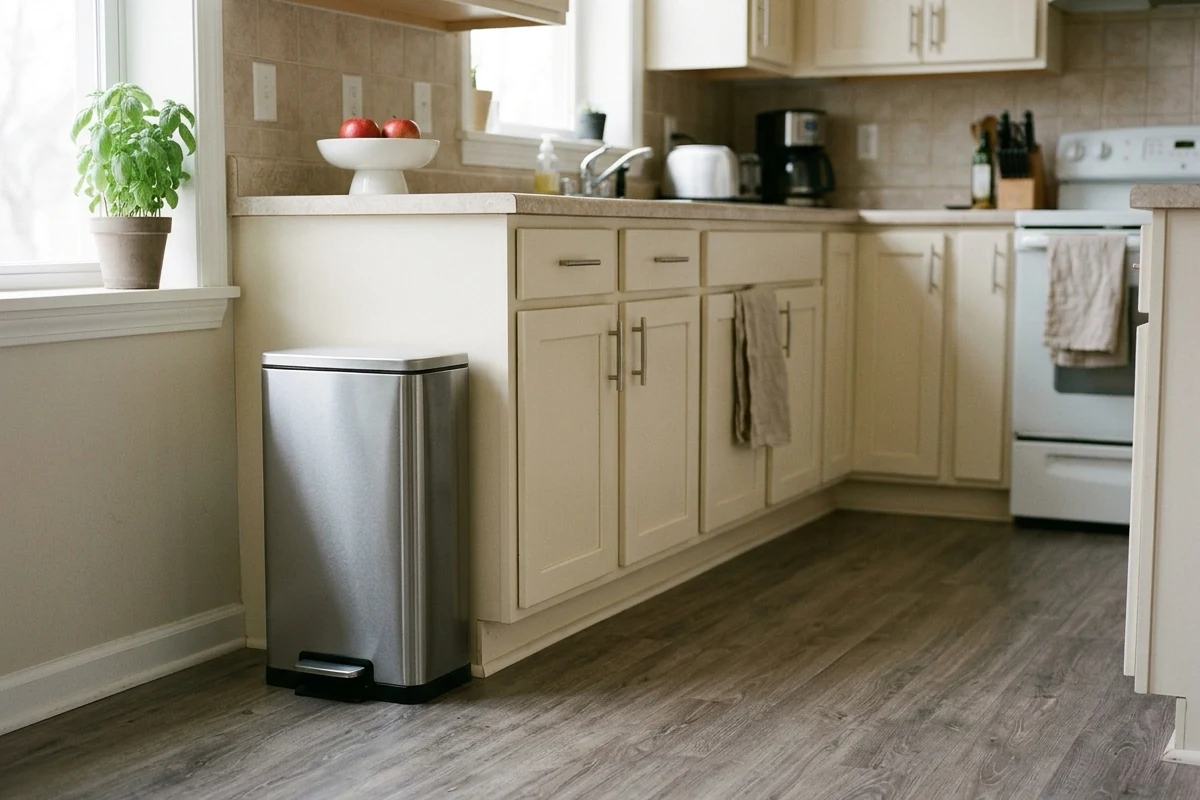
Choose which space you can afford to give up
Picture the bin in its proposed position while the kitchen is being used. A narrow floor spot may also be where you stand to unload the dishwasher. An apparently available cabinet may hold the colander, cleaning supplies, or recycling you would need to move.
For a floor-standing can, name the space it occupies and the activity that might lose room. For a cabinet system, list what would leave the cabinet and give those belongings a specific destination. Moving the colander onto an already crowded counter simply transfers the problem.
If several groups need new homes, use a small kitchen storage plan first. Here, the decision is narrower: can a different waste arrangement improve disposal without making storage or movement worse?
Leave the current bin in the comparison. If it opens, empties, and cleans comfortably, appearance alone may not justify giving up useful cabinet space.
Compare the arrangements before comparing products
The distinction is not just visible versus hidden. A cabinet bin can sit loose or run on installed slides, while freestanding models may have a pedal-operated lid or an open top.
| Format | Space you give up | Movement to check | Purchase commitment |
|---|---|---|---|
| Slim step can | A floor position plus room to use the pedal and lid | Press the pedal to discard waste; lift the full bag clear to empty. | Freestanding can and suitable liners |
| Slim open-top can | A floor position and access above the opening | Deposit waste; remove the top or rim as instructed for emptying | Freestanding can; confirm how its liner is retained |
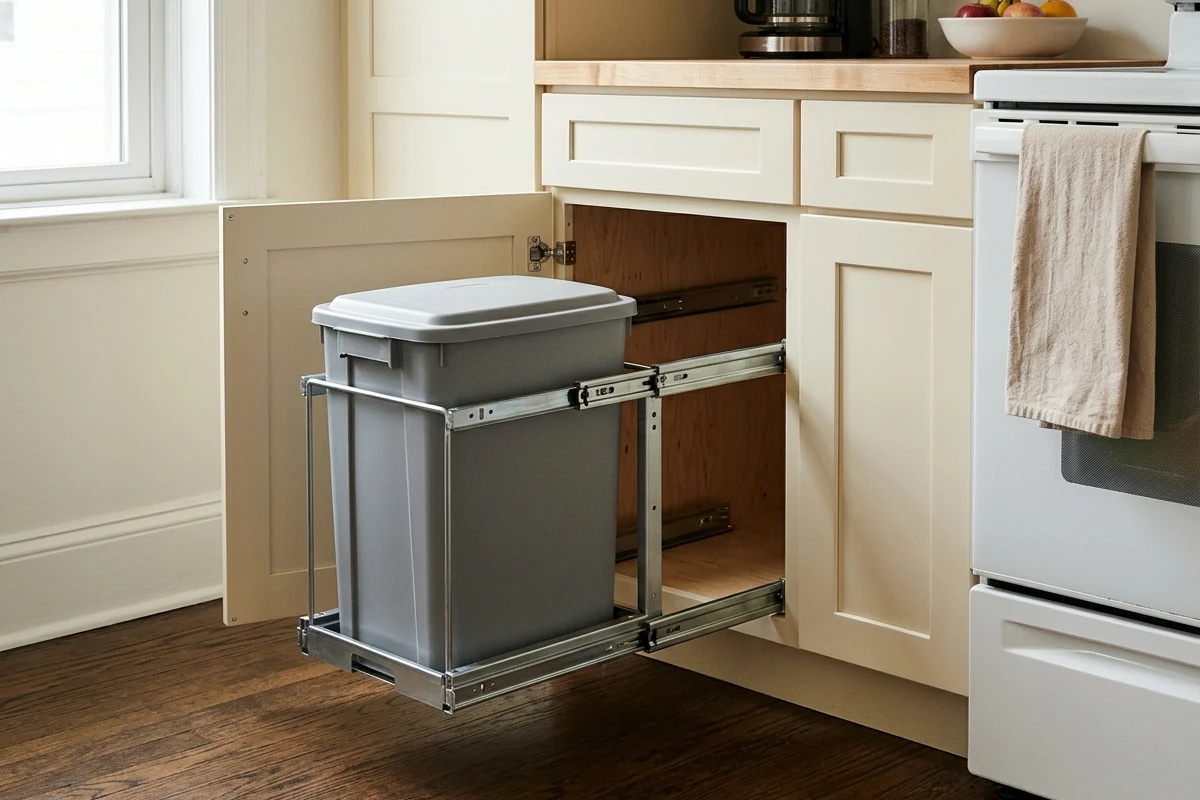
| Installed cabinet pull-out | Cabinet storage plus space in front during use | For disposal: open the cabinet, extend the unit, open any lid. For emptying: check bag/bucket removal separately. | Complete bin/frame system and verified installation requirements |
| Loose cabinet bin | Cabinet storage and a removal route through the opening | Open the door; reach the bin or bring it out | A suitable existing or new bin; no slide installation |
An open top removes the lid-opening step during disposal, but it does not eliminate the space needed for emptying. A loose bin avoids installing a frame, but you still need to reach it and bring it through the cabinet opening. Compare those actions with the people who will use the kitchen.
Use the documented examples to understand the tradeoffs
Simplehuman CW2044: check clearance above the lid
Simplehuman lists the brushed CW2044 Slim Step Can at 45 liters. Its published drawing gives 10.2 inches wide, 21.5 inches deep, and 24.4 inches high, with 41 inches shown in the illustrated open state. That last measurement matters when considering a position beneath a counter overhang. It does not establish the room needed to lift out a full bag. CW2044 product page, manufacturer dimension drawing.
The model uses a pedal, and its liner rim flips up for bag changes. Check both the disposal position and that larger emptying task. A can that fits against a wall while closed may still be inconvenient where you need to stand or lift. CW2044 liner-rim description.
Simplehuman CW1124: distinguish the product from the cabinet it needs
The CW1124 is a 30-liter under-counter pull-out. Its drawing labels the product 9.8 inches wide, 17.7 inches deep, and 19.1 inches high. The product description identifies a handle for pulling the frame forward, and the support page describes a removable bucket. CW1124 product page, dimension drawing, model support.
Confirm the minimum cabinet opening and applicable instructions with Simplehuman before buying: the drawing's larger outline is unexplained, and the support page links to a sheet whose filename refers to a 35-liter dual-compartment model. Neither establishes installation requirements for CW1124 here. Linked instruction download.
For this candidate, ask how far the loaded frame extends and whether the bucket can be lifted clear at that position. A description of pull-out movement does not resolve interference with your sink plumbing, door, or standing space.
IKEA HÅLLBAR: the frame and bins are separate parts of the decision
IKEA lists the HÅLLBAR frame, 204.228.53, at 10⅜ inches wide, 17¾ inches deep, and 12⅜ inches high. It mounts to the cabinet bottom, and screws are included. Confirm that the mounting method and supplied hardware suit your actual cabinet. These are frame dimensions, not the height of a complete loaded arrangement or a universal cabinet-opening requirement. HÅLLBAR frame specifications, frame assembly instructions.
The 803.980.58 bin has an upper exterior measuring 10⅜ inches wide by 8⅜ inches deep and a height of 12⅞ inches. IKEA documents a removable lid, a folding carrying handle, and a removable ring that retains the waste bag. It also permits freestanding use, so the bin can be considered separately from the installed frame. HÅLLBAR bin specifications and features.
Keep the capacity labels qualified. IKEA's US page calls that individual bin “3 gallon,” while the 793.088.03 combination containing two of those bins and one frame is labeled “5 gallon.” Those labels do not support an exact combined-capacity calculation. If capacity determines your choice, request clarification rather than treating the package as two precisely measured three-gallon compartments. HÅLLBAR combination contents and capacity label.
Check disposal, bag removal and cleaning access
Walk through the disposal movement
Start where you would normally have waste in your hand, such as beside the preparation surface. Follow the proposed action: approach the pedal, reach an open top, or open a cabinet and bring a bin forward. Include any separate lid. Consider where the cabinet door rests and whether you would have to move it again to reach the bin.
Check the arrangement with other normal activities in mind. Can someone use the sink while the pull-out is extended? Would an open dishwasher occupy the same standing space? A hidden bin still uses room outside the cabinet when accessed.
Take a waste-specific measurement record
Use measurements from your kitchen and exact documentation for a candidate. Keep these entries separate:
-
Floor position: the available width and depth, including handles or other projections nearby, plus the available height for the closed can beneath any countertop or overhang. Record where you would stand, reach, or press the pedal.
-
Cabinet opening and interior: the clear entry point separately from the space behind it. Include the lower frame lip, center stile, hinges, and the door position you can actually achieve.
-
Sink-area obstructions: the sink bowl, disposal, pipes, hoses, and their routes. Check the whole proposed bin and frame location, not just the height below one pipe.
-
Movement during use: the lid's opening space, pull-out extension, and any collision with an adjacent door or appliance. Leave undocumented travel or opening requirements unconfirmed.
-
Emptying and cleaning: the route for the full bag and, separately, the bucket or bin. Check what must lift, tilt, or come forward and where you would put it down.
For a broader cabinet record, use these cabinet opening and usable-space checks. Do not subtract a standard allowance and declare the bin a fit. A paper footprint can show where a closed product would sit; it cannot establish stability, mounting compatibility, or full-bag removal.
Check the task that happens when the bin is full
With your existing bin, observe an ordinary bag change: where the bag catches, what you move aside, and whether you can lift comfortably. For a proposed model, ask for a demonstration or documentation of the removal sequence. Do not infer that a bucket can be removed beneath a pipe simply because it sits beneath it while closed.
Cleaning adds another question. Can you reach the cabinet surface beneath and behind the system, as well as remove the intended parts? Follow the exact product's care instructions. A removable bucket does not establish that the frame detaches easily or that either part is dishwasher-safe.
Choose capacity around your actual waste
Use your current arrangement as a reference. Which items fill it awkwardly? Does bulky packaging prevent you from using space below? Do trash and recycling need separate containers, and where do those containers go when you empty them?
A published volume cannot answer those questions on its own. Compare the opening and the waste you actually handle, not just the number of liters.
If you separate recycling, compare each compartment with its intended job. Unused room on one side does not automatically help when the other side is full. Do not assume every material belongs in the same recycling stream; use your local collection instructions when deciding what to separate.
Count installation and ongoing purchase requirements
Compare complete purchases
The following are US advertised-price snapshots from the October 28, 2026 research, not current checkout quotes or delivered totals. Recheck the exact model, contents, availability, and price before ordering.
| Documented example | Advertised item price | What remains to account for |
|---|---|---|
| Simplehuman CW2044, brushed | $110 | Suitable liners, tax and any applicable delivery charge |
| Simplehuman CW1124 | $100 | Confirmed installation requirements and included fasteners, liners, tax, delivery and any paid installation |
| HÅLLBAR frame 204.228.53 | $29.99 | Compatible bins; the frame price is not a complete waste system |
| HÅLLBAR combination 793.088.03 | $49.97 | Includes one frame and two 803.980.58 bins; account for liners, installation needs, tax and delivery |
Price and contents sources: CW2044, CW1124, HÅLLBAR frame, HÅLLBAR combination.
Include required tools or supplies you do not own and any cabinet preparation that has actually been established. Keep uncertain work separate rather than giving the purchase a misleadingly complete total.
Compare liner costs
Simplehuman identifies Code N liners for CW2044 and Code K for CW1124. The researched pages listed 100-pack prices of $32 and $30, respectively: 32 cents and 30 cents per liner, before applicable charges. Those figures compare the listed packs, not monthly spending or the cost of collecting the same amount of waste. CW2044 liner listing, CW1124 liner listing.
This does not establish that proprietary liners are mandatory or that an alternative bag fits equally well. Confirm the intended bag's size and retention before relying on an alternative. The reviewed HÅLLBAR documentation establishes a bag-retaining ring but not a specific compatible liner SKU, so no liner price is assigned to it here. HÅLLBAR bag-ring description.
Keep installation permission separate from product fit
If you rent, resolve permission for fastening or altering the cabinet before choosing an installed system. A frame that can later be unscrewed does not promise an unchanged cabinet. For the broader permission and removal questions, see renter-friendly kitchen upgrade checks.
A loose bin or freestanding can avoids installing slides, although access still needs checking. Do not modify a screw-mounted frame to make it a no-drill installation unless the manufacturer explicitly supports that method.
Apply the comparison to your kitchen
These three situations are illustrative, not measured installations or fit verdicts for the products above.
The cabinet already holds everyday cookware
A household considers replacing a floor bin with a pull-out in the cabinet holding its colander and mixing bowls. The proposed destination for those items is the preparation counter. If the current bin already has a workable floor position, keeping it may preserve both storage and preparation space. Hiding waste would not compensate for moving frequently used cookware into the way.
The floor bin obstructs a useful route
A bin sits where someone needs to pass while another person uses the sink. A nearby cabinet holds rarely used serving pieces that have a plausible home on an existing shelf elsewhere. An in-cabinet option deserves investigation, provided those pieces remain accessible and the bin can be used and emptied without blocking the same route. If plumbing, the door, or bag removal defeats the arrangement, clearing the floor on paper is not enough.
The rental has an uncertain mounting option
A renter wants hidden waste storage but has neither permission for drilling nor confirmed pull-out requirements. Keeping the current bin is the immediate option. Repositioning it, or checking whether an existing loose bin can work inside the cabinet, may answer the problem without buying hardware. A different location is useful only if disposal, emptying, and cleaning remain practical.
Choose the arrangement that improves disposal, leaves a workable home for displaced belongings, and lets you remove a full bag comfortably. Keep the purchase on hold until you can confirm all three; keeping or repositioning your current bin may be the better choice.