Cabinet Storage Ideas for a Small Kitchen: Start With Usable Space
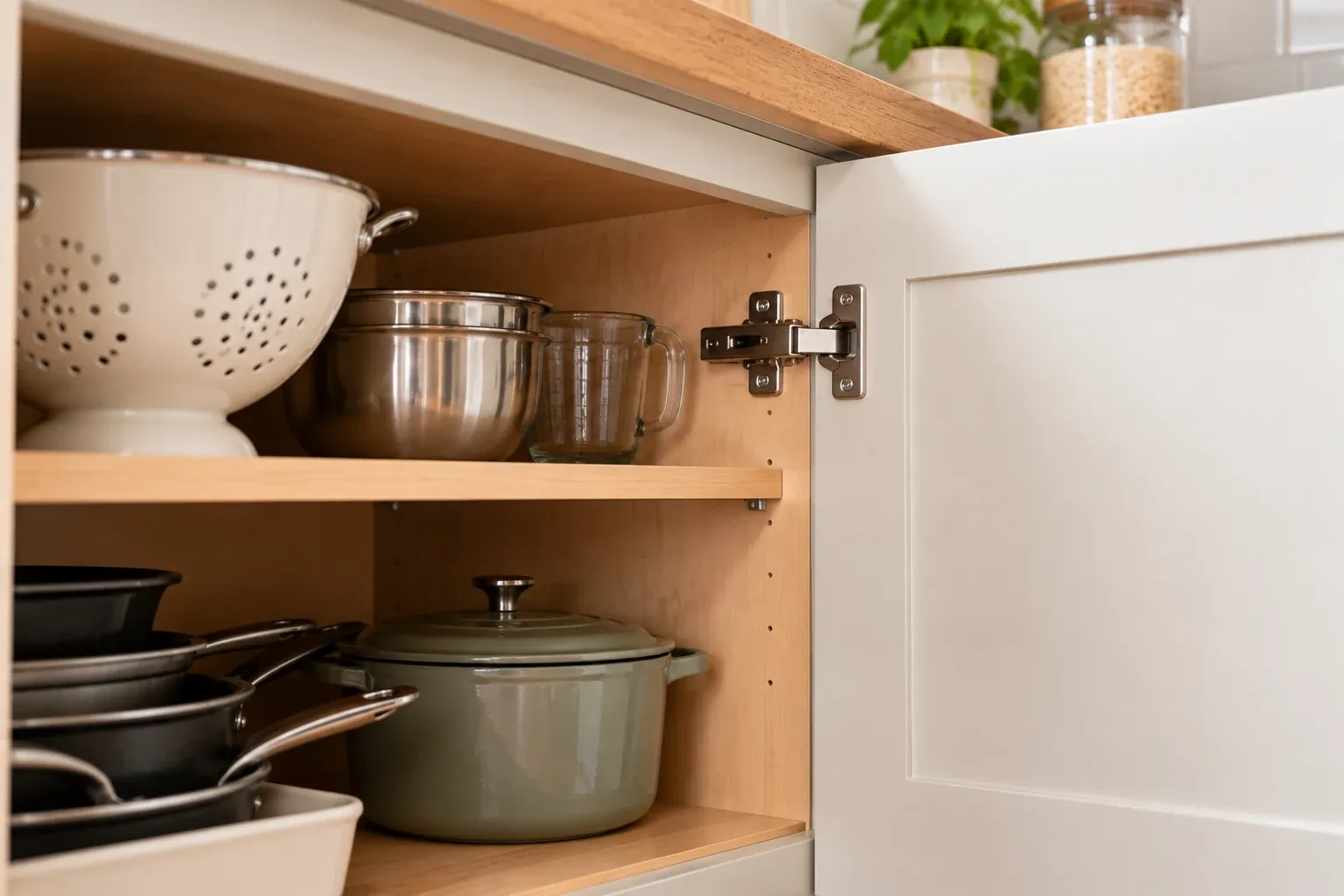
Choose one cabinet and one item that is frustrating to get out. Perhaps a baking sheet is trapped beneath other trays, or a lid disappears behind the pans. Start with that specific retrieval problem before choosing an organizer.
The goal is an arrangement you can use with the cabinet you have: its opening, shelves, doors and hardware included. A tidy interior is only part of the job. You also need to get the intended item out and put it back.
Give this cabinet a specific job
Write down what you want the cabinet to hold and which item should be easiest to retrieve. Be concrete: “baking sheets and cooling racks, with the baking sheet accessible on its own” is more useful than “baking supplies.”
If you are still deciding which cabinet should hold which belongings, start with the room-wide small kitchen storage plan. Here, focus on how the chosen contents will work inside one cabinet.
Notice where retrieval breaks down:
| What happens now? | Arrangement to consider | Question to answer |
|---|---|---|
| A tray is buried in a stack | Separate upright slots, if a suitable divider fits | Can each tray come out without tipping or moving its neighbors? |
| Small belongings disappear behind larger ones | A defined front group and a separate rear group | Can you reach the rear group without unloading the front? |
| A lid is hard to distinguish from the others | A separate lid area beside the pans | Can you identify and remove the right lid? |
| Contents at the back remain awkward to reach | A fitted pull-out, if compatible | Will the complete unit travel through the opening with the intended contents? |
These are candidate arrangements, not a shopping list. Keep the existing shelf arrangement as an option when it already answers the retrieval question.
Record the opening before choosing an insert
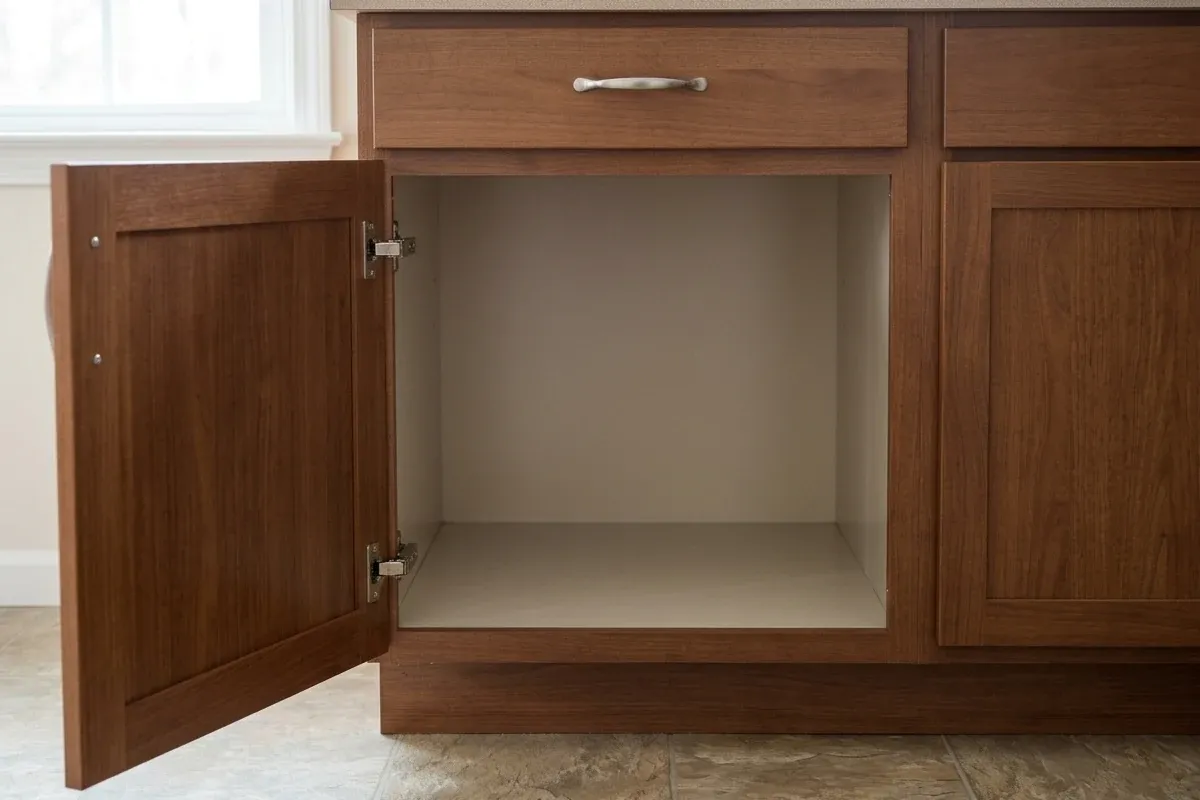
Before choosing an insert, ask its supplier which opening and interior measurements the exact model requires. Include photos showing the door hinges, any plumbing and other obstructions, and ask the supplier to confirm whether these interfere with installation or movement. Keep fit marked as unconfirmed until those questions are resolved.
Make a simple sketch of the cabinet with its door open. Label the opening separately from the space behind it. Record where you took each measurement; “width at shelf level” tells you more than an unexplained number.
Use this record when comparing an organizer with its own instructions:
| Record | What to include |
|---|---|
| Cabinet construction | Face frame or frameless, if known; photograph it for the supplier if uncertain |
| Opening | Inside width and height at the intended entry point |
| Interior | Available depth and the space at the proposed shelf or organizer position |
| Obstructions | Location of hinges, a center divider, pipes or other parts occupying that space |
| Door position | Where the open door sits relative to the proposed removal or pull-out path |
| Intended contents | The actual items, including projecting handles and lids |
| Unanswered fit questions | Anything the product drawing or supplier still needs to confirm |
This is a planning record, not an installation drawing. Do not subtract a universal allowance or assume that matching width alone confirms fit. For a prospective insert, compare the exact model's required opening, installed space and moving parts with your record. Leave an uncertain fit marked “not confirmed.”
Choose an arrangement around the item you remove
Separate flat items when the stack is the problem
For baking sheets or cutting boards, sketch separate upright spaces as an alternative to the existing stack. Then check the path of the largest item. Consider its handle or rim, the shelf above and the cabinet opening, as well as the place where it would stand.
For example, in a hypothetical cabinet, the baking sheet fits upright at the back but cannot come through the opening in that position. That proposed arrangement has not solved the task. Try another orientation on paper before selecting a divider. Any divider you buy still needs its own fit and support checks.
Make a deep shelf's front and back deliberate
Name the contents of both areas. If you propose putting a cake stand behind mixing bowls, ask how you will remove it when you need it. You may accept moving the bowls for an occasional task; you may decide that the exchange is too cumbersome. Record the tradeoff rather than calling the rear area “extra storage.”
A removable container is another possibility for a small group of belongings, but check it with the items inside. The container itself must pass through the opening, and you need to be comfortable handling that group together. There is no need to contain an item that already has a clear, usable place.
Treat a pull-out as a fit question before a convenience upgrade
A pull-out is worth investigating when your specific aim is to bring rear contents forward. Sketch what it should hold and which problem it should address. Then ask for the exact installation drawing, mounting requirements and load information for the candidate model. This guide does not establish those details for a particular product.
Keep the door and hinges in the fit conversation. Do not assume a hardware change is interchangeable: Blum's hinge range includes different applications and mounting plates. Ask the cabinet or hardware supplier to confirm the proposed combination. Blum CLIP top application information.
If the issue is the cabinet opening or cabinet construction itself, use planning small kitchen cabinets to assess the broader choice before committing to an interior accessory.
Compare two arrangements for the same contents
Use the same cabinet and item list in both columns. Option A can be your current arrangement; Option B can be a proposed change. Fill in observations for what already exists and questions for anything you have not tried or verified.
| Decision record | Option A | Option B |
|---|---|---|
| Where does the priority item sit? | Record the priority item’s position. | Record the priority item’s position. |
| What must move before it comes out? | Identify what must move first. | Identify what must move first. |
| Can it return without rebuilding a stack? | Describe how the item returns. | Describe how the item returns. |
| Which intended items have no workable place? | List items without a workable place. | List items without a workable place. |
| Is fit observed, documented or still unknown? | Record fit evidence or uncertainty. | Record fit evidence or uncertainty. |
| Does this require an accessory or cabinet alteration? | Identify any accessory or alteration required. | Identify any accessory or alteration required. |
Prefer the option that answers your retrieval problem while respecting the constraints you recorded. A proposal with an unresolved fit question remains a proposal, even if its sketch looks neater.
If the arrangement works but belongings repeatedly return to the wrong place, the next task is a routine. Use small kitchen organization ideas for that daily follow-through.
Know when the next decision belongs elsewhere
For cabinets being considered as pantry space, move to pantry planning without a separate pantry for the food-storage task; this guide addresses cabinet access, not food-storage conditions.
When a possible purchase becomes a project, compare its complete scope with small kitchen upgrades under $100 with verified totals. Do not assume that a cabinet accessory or its installation qualifies for that limit.
If you are weighing new fronts or replacement cabinets alongside storage changes, use cabinet refresh and replacement options. Take your cabinet record with you: it explains what the proposed upgrade needs to improve beyond appearance.