Cabinet Upgrades for Small Kitchens: Refresh or Replace?
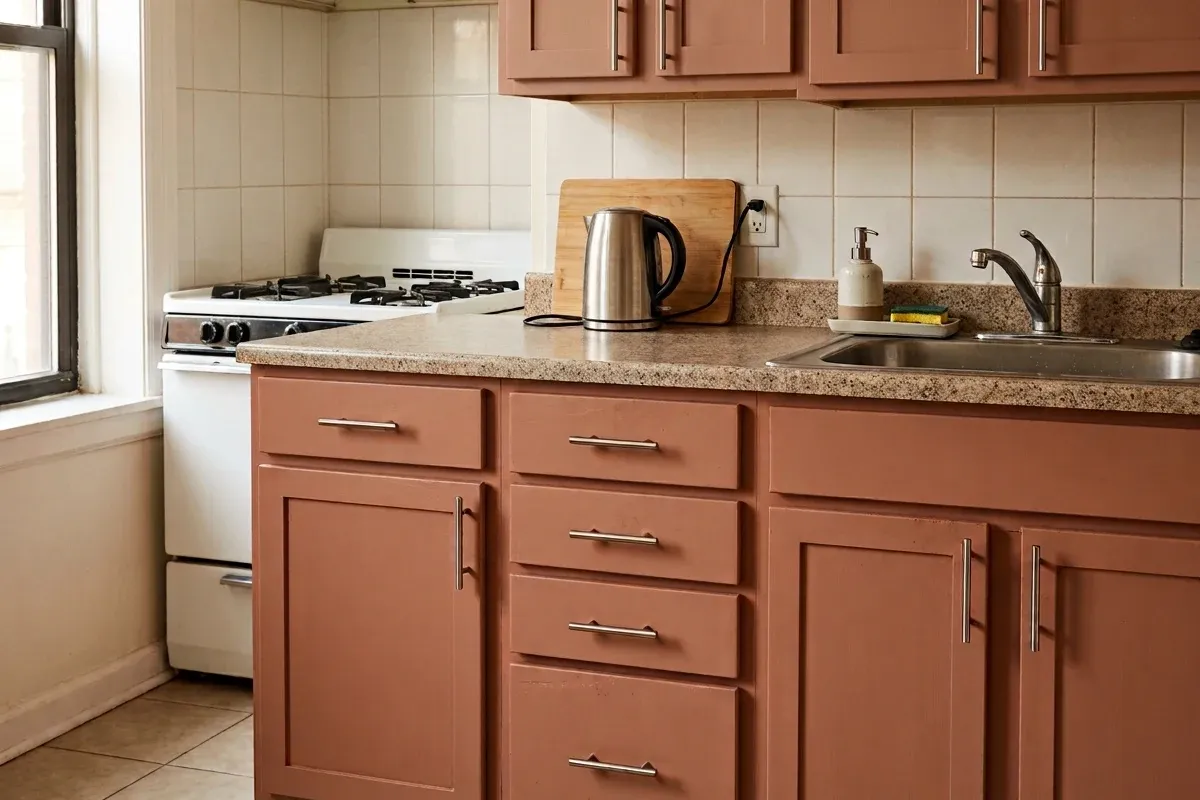
A cabinet upgrade proposal should say what you will keep as clearly as what you will get. New fronts may address the appearance you dislike. They do not, by themselves, answer a request to move the cabinets or change the storage arrangement.
Before comparing offers, name the result you want and the parts you are willing to retain. Then compare the proposed work against that result. Refreshing, refacing and replacing are different scopes, not a universal ladder from good to better.
Define the upgrade before comparing it
Use these working descriptions, then ask each provider to spell out its own scope:
| Route | What the work concerns | What to clarify |
|---|---|---|
| Hardware refresh | Selected handles, knobs or functional hardware | Which parts change and whether the exact replacements are compatible |
| Refinishing | A new finish on retained surfaces | Which surfaces are included and how their suitability will be assessed |
| Refacing | Retained cabinet boxes with replacement fronts and treatment of exposed faces | Exactly which drawers, interiors and hardware are included |
| Replacement | New cabinet boxes and fronts | Whether the proposed positions and interiors also change |
The Home Depot's refacing service illustrates why the written scope matters: it retains cabinet structure while changing fronts, and treats some other upgrades as additional work. Its service description is a provider example, not a standard package every contractor must follow. Home Depot cabinet refacing.
If you cannot yet say whether the problem concerns cabinet construction, storage or access, use planning small kitchen cabinets to establish that requirement first.
Choose which routes deserve a proposal
Investigate a hardware refresh for a specific hardware change
This route belongs on your shortlist when you can name the part you want to change and the reason. “I want a different handle shape” is a clearer request than “I want the cabinets upgraded.” Keep decorative hardware and hinges separate in that request.
For handles, ask the supplier to check the proposed part against the existing fixing arrangement and front. For hinges, request the exact hinge-and-plate combination for the door and cabinet. Blum's range distinguishes applications and mounting plates; it is not evidence that an arbitrary replacement will work. Blum hinge application information.
Leave this route off your shortlist if the real goal is new cabinet positions. A change to the selected hardware does not deliver that scope.
Investigate refinishing when retaining the fronts is part of the goal
Consider a refinishing proposal if you want to keep the fronts and investigate a different finish. Ask the provider to identify the existing surface and coating, explain the proposed preparation and specify the finish system. Do not treat “paint the cabinets” as a complete description of the work.
Sherwin-Williams' refinishing guide distinguishes preparation and primer choices for different surfaces, including laminate and unfinished wood. The planning lesson is to establish the substrate and coating system; the guide does not confirm that an unidentified cabinet is suitable for repainting. Sherwin-Williams cabinet refinishing guide.
Ask which faces, edges and interiors the proposal covers. If you are dissatisfied with the door profile itself, compare a front-changing option too: keeping that profile is not the result you requested.
Investigate refacing when you want different fronts and want to retain the boxes
Put the retained boxes on the assessment list, not just the new door samples. Ask the provider to explain whether they are suitable for the proposed work and identify anything excluded from that assessment.
Then list the interior features you expect to keep. If rear contents are difficult to reach, ask for that problem to be addressed explicitly in the proposal. Do not assume it is included because the package is called a cabinet makeover.
Use cabinet storage ideas based on usable space to describe that interior task. A specific request, such as access to the rear cookware, gives you something to check against the proposal.
Investigate replacement when new boxes are part of the requirement
Seek a replacement proposal when you want a different cabinet arrangement, or when professional assessment leaves the existing boxes unsuitable for the work you want. Ask for a drawing and cabinet schedule that show the proposed result.
Compare that result with your original requirement. Are you getting the drawer arrangement or access change you requested, or simply new cabinetry in the same configuration? Replacement is a scope choice; it is not proof that a plan will work better for you.
Do not diagnose uncertain damage yourself to justify either retention or replacement. Ask the assessor to distinguish what was observed, what needs further investigation and what the proposed work addresses.
Resolve preparation and warranty questions before committing
If a project will disturb old paint, settle that issue before work begins. For renovation, repair or painting in pre-1978 homes, EPA recommends hiring a lead-safe certified contractor. This article does not provide paint-removal or hazardous-material procedures. EPA guidance for homeowners.
Ask for the applicable cabinet warranty and the proposed work warranty separately. KraftMaid, for example, excludes damage or defects caused by alteration or improper installation in its published warranty. That does not mean every modification automatically voids every cabinet warranty; check the actual policy and proposed work. KraftMaid warranty.
For each proposal, record who will confirm material compatibility, who will perform the work and who will handle a problem afterward. An unanswered question belongs beside the offer, not in an assumption about what its headline includes.
Compare two written scopes, not just two totals
Ask providers to respond to the same brief. If one proposal changes only fronts and another also changes drawer interiors, show that difference before comparing the totals.
| Comparison field | Proposal A | Proposal B |
|---|---|---|
| Desired result the work addresses | Describe the result addressed. | Describe the result addressed. |
| Boxes, fronts and interiors retained | Identify retained boxes, fronts, and interiors. | Identify retained boxes, fronts, and interiors. |
| Parts replaced, with specifications | List replacement parts and specifications. | List replacement parts and specifications. |
| Surface preparation and finish scope | Record preparation and finish scope. | Record preparation and finish scope. |
| Condition and compatibility checks included | Identify the included checks. | Identify the included checks. |
| Removal, disposal and making-good work included or excluded | Record included and excluded work. | Record included and excluded work. |
| Effects on countertops, adjacent finishes or utilities to assess | List effects that need assessment. | List effects that need assessment. |
| Expected kitchen access during work, as stated by provider | Record the provider’s access expectations. | Record the provider’s access expectations. |
| Written schedule and dependencies | Record the schedule and dependencies. | Record the schedule and dependencies. |
| Itemized total, date and exclusions | Record the dated total and exclusions. | Record the dated total and exclusions. |
| Product warranty and work warranty | Record product and work warranties separately. | Record product and work warranties separately. |
| Open questions and person responsible | List open questions and responsible people. | List open questions and responsible people. |
Leave unknown entries blank or label them “awaiting provider.” Do not enter zero for an unquoted item. This worksheet collects project-specific information; it does not supply a market price or predict the duration of the work.
Imagine two hypothetical offers: one changes the fronts, while the other also replaces the drawer interiors you dislike. Neither total is directly comparable until you decide whether the drawer change is part of your requirement. Ask for comparable scopes rather than choosing from the headline amounts alone.
For the broader spending decision, use budget small kitchen makeover planning to weigh the cabinet project against your other priorities.
If you are considering a narrowly limited project instead, small kitchen upgrades under $100 with verified totals is the appropriate costed comparison. That limit is not a price estimate for any of the cabinet routes here.
Make a conditional choice you can explain
Explain why you prefer the scope, what it addresses, which parts it retains, and what still needs confirmation.
For example: “I prefer a refacing proposal because I want different fronts while retaining the cabinet arrangement, provided the box assessment and written interior scope match my requirements.” This is a hypothetical decision, not a verdict on an actual kitchen.
If the condition cannot be met, return to the competing proposal. The useful outcome is a choice tied to your kitchen and a defined scope, with no hidden assumption about what the upgrade will deliver.