Air Fryer vs. Air Fryer Toaster Oven for a Small Kitchen: Which Uses Counter Space Better?
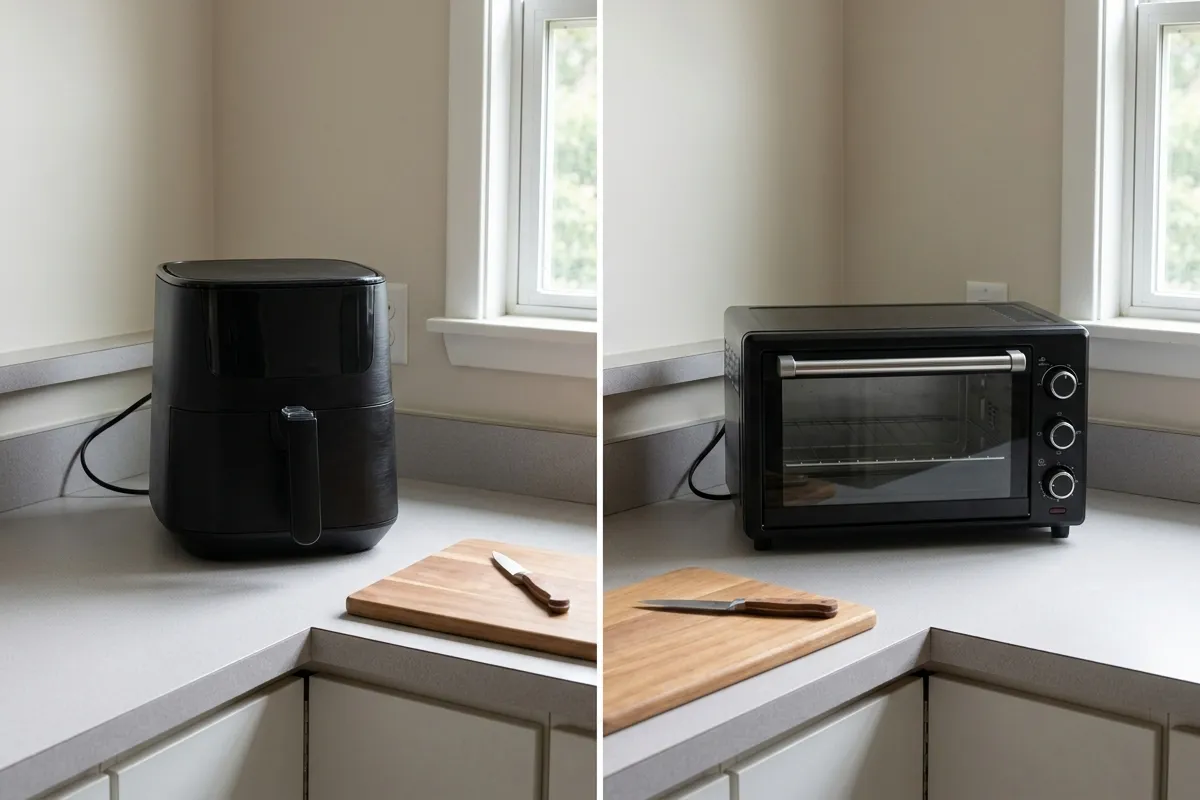
An air fryer that fits on the counter can still crowd the place where you prepare dinner. Its basket needs room to come out, hot accessories need somewhere to land, and the surrounding space must meet the manufacturer's instructions. A larger combination oven might earn its position by replacing a toaster—but only if you actually remove the toaster.
When comparing an air fryer vs. air fryer toaster oven for a small kitchen, look at the complete setup during a meal. The useful choice is the one that handles your regular cooking while leaving a workable preparation area. Neither format wins that comparison automatically.
Basket air fryer vs. air fryer toaster oven: what changes on the counter?
A basket-style air fryer gives you a drawer to load and remove. An air fryer toaster oven gives you an oven door and a choice of cooking accessories. Those differences change how you use the space in front of the appliance, as well as what stays on the counter between meals.
The examples here illustrate specific designs, not product rankings. COSORI's Lite CAF-LI211 and TurboBlaze CAF-DC601-KUS use baskets with crisper plates. Cuisinart's TOA-26 and Breville's Smart Oven Air Fryer BOV860 include oven racks, pans, and air-frying baskets. COSORI Lite, TurboBlaze, Cuisinart TOA-26, Breville BOV860.
Start with the job you want to add or replace. If that is still unclear, use how to choose appliances for a small kitchen before comparing these two formats.
Compare the space each appliance needs during use
Check width, depth, height, and handle projections
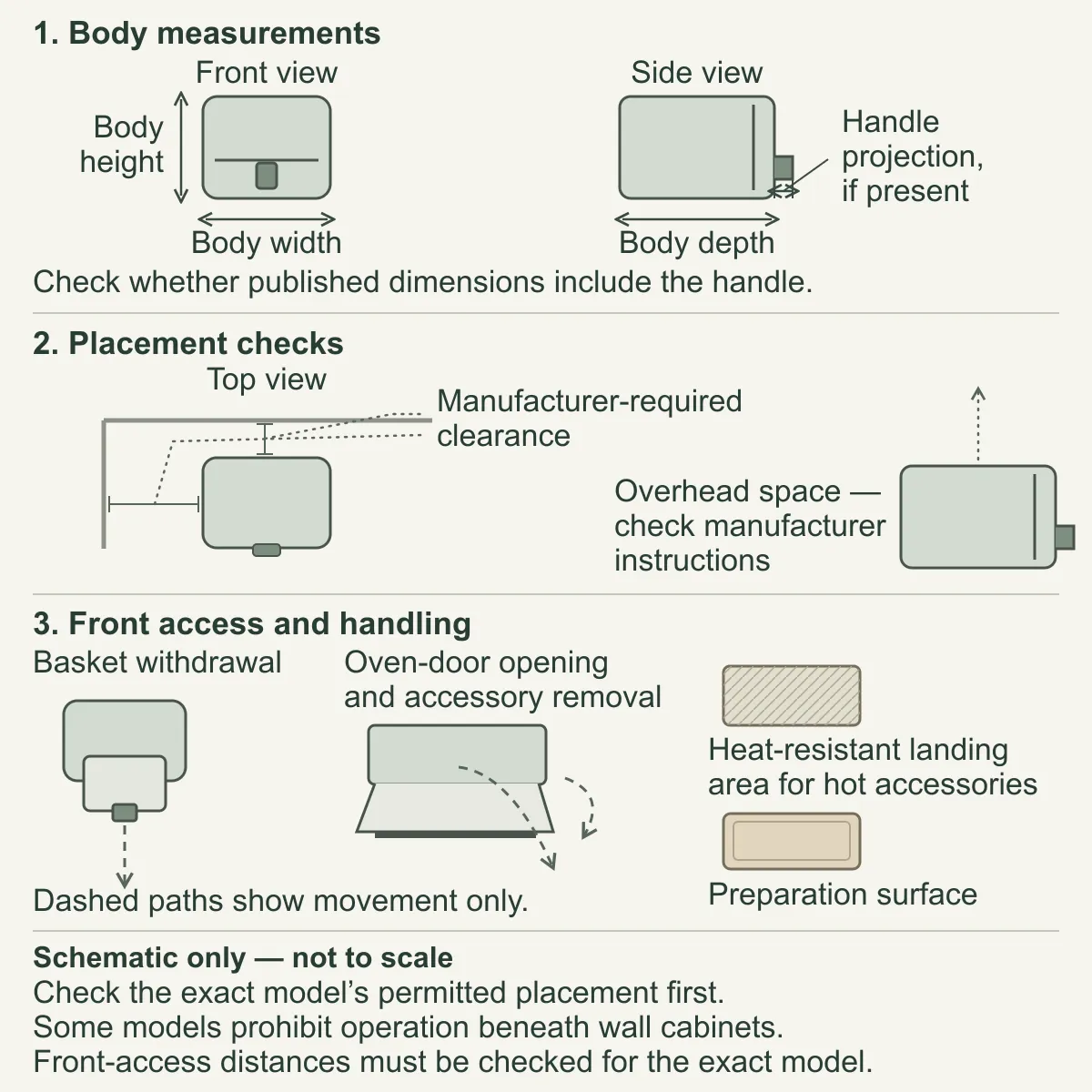
Measure the proposed position in three directions. Include nearby objects and any overhead obstruction in your sketch. Then copy the exact candidate's published measurements, preserving their labels and whether they include the handle.
The examples show why that detail matters:
Swipe to see more →
| Model | Published dimensions in inches | Detail to preserve |
|---|---|---|
| COSORI Lite CAF-LI211 | 10.1 × 8.3 × 10.5 including handle; 8.0 × 8.3 × 10.5 without | The specification block does not explicitly label the axes. |
| COSORI TurboBlaze CAF-DC601-KUS | 11.8 × 14.4 × 11.9 including handle; 11.8 × 11.8 × 11.9 without | These figures belong to the dark-gray US model; axes are not explicitly labeled. |
| Cuisinart TOA-26 | 11.5 L × 12.5 W × 11.5 H | Handle inclusion is unspecified. |
| Breville BOV860 | 18.9 W × 15.9 D × 10.9 H | Handle inclusion is unspecified in the displayed specification block. |
These are manufacturer-listed dimensions, not measured operating footprints. Sources: Lite specifications, TurboBlaze specifications, TOA-26 specifications, BOV860 specifications.
If an axis or projection is unclear, ask the manufacturer to confirm it before relying on a tight fit. Do not assume every specification uses the same dimension order.
Allow for basket removal or the open oven door
Mark the movement in front of each candidate. For a basket model, check the full withdrawal path and where you would handle the loaded basket. For an oven, account for the door and removing a hot pan or rack.
The reviewed documents do not establish numeric front-access distances for these examples. Do not add a guessed allowance. Seek a manufacturer measurement or check the exact appliance in person before buying.
Also identify a suitable place to set hot accessories. In a narrow kitchen, an appliance may fit while its unloading routine occupies the only cutting-board position. Rehearse that conflict on paper with your usual meal in mind.
Check the manual before placing either beneath cabinets
Cabinet suitability is model-specific. The COSORI Lite and TurboBlaze manuals specify five inches behind and above the appliance, plus room to remove the basket. Those instructions do not establish a clearance rule for other air fryers. Lite setup, page 10, TurboBlaze setup, page 10.
The Cuisinart TOA-26 manual explicitly prohibits operation under wall cabinets or in an appliance garage. Its separate instruction to move the unit two to four inches from walls or countertop objects does not override that prohibition. TOA-26 manual, pages 2–5.
Breville's BOV860 setup calls for four inches on both sides and six inches above. Its safety guidance also recommends 10 cm around the oven and excludes small appliance enclosures. BOV860 manual, pages 3 and 9.
Read the full placement instructions for the exact model. A low appliance body is not proof that the proposed location is permitted.
Compare cooking arrangements, not just advertised capacity
Match the basket or tray to your usual food
Choose three tasks you expect to repeat: perhaps a portion of vegetables, breakfast toast, and a small baked dish. Write down the actual quantities and whether you need them ready together.
COSORI lists the Lite at 2.1 quarts and TurboBlaze at six quarts. Cuisinart describes TOA-26 air-frying capacity as up to 2.5 pounds, while Breville lists six-slice toasting and includes a 13-inch pizza pan with BOV860. These describe different loading tasks; they are not a common capacity scale. Lite capacity, TurboBlaze capacity, TOA-26 capacity, BOV860 features.
Compare how your food would be arranged in the permitted cooking setup. Would the intended portion require another batch? If so, is that acceptable, and where would the first batch wait? That question connects cooking capacity to the space you need outside the appliance.
For example, compare the same portion of vegetables in each candidate rather than filling each to its advertised maximum. Ask whether the documented arrangement suits that portion and whether your usual main dish would need separate equipment. You are choosing a useful addition to your meal routine, not simply the largest capacity that fits your budget.
Check cookware fit and permitted rack positions
For a dish you already own, include its handles and the height of the loaded food. Check both entry through the opening and the permitted position inside. Exterior measurements cannot confirm either.
Multiple accessories also do not mean every arrangement can be used together. Cuisinart recommends fitting the TOA-26 air-fry basket into its baking pan for air frying. Follow the exact model's loading guidance rather than counting every rack position as another simultaneous cooking surface. TOA-26 accessory guidance, pages 4–6.
Will the new appliance replace something already on the counter?
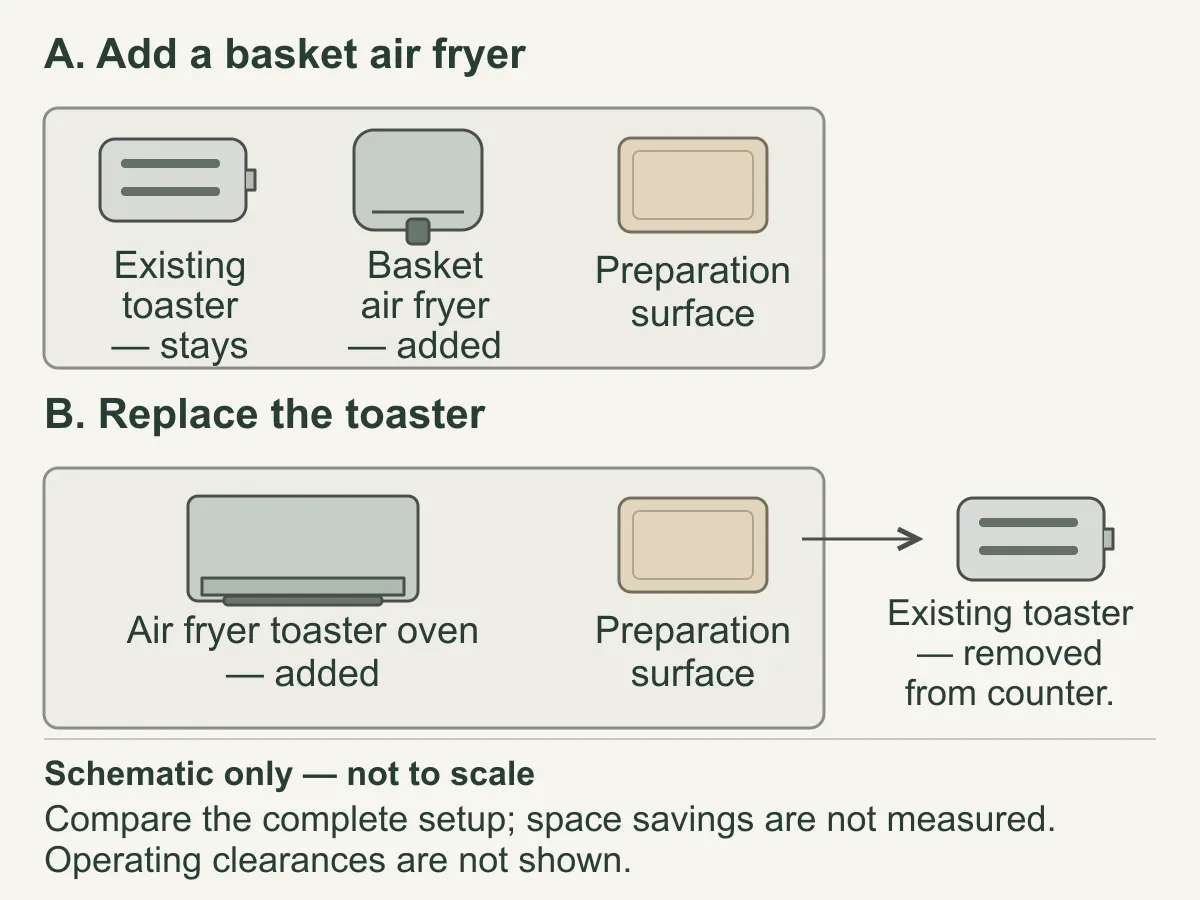
Replacing a toaster or toaster oven
Both oven examples include a toast function, making toaster replacement a possibility to investigate. That does not establish identical toast results or an identical routine. TOA-26 functions, BOV860 functions.
List the jobs your existing toaster or toaster oven performs. Check those jobs against the new candidate, then decide whether you would actually retire the old appliance. Keeping both removes much of the space-saving case for consolidation.
Consider timing, too. If you regularly make toast while another food cooks, would sharing one appliance force an inconvenient sequence? A combined purchase makes sense only if its everyday compromises work for you.
Adding another appliance without removing one
If the purchase is an addition, compare the whole setup: existing appliances, new appliance, and remaining preparation surface. A smaller new unit can still create more crowding than a replacement that occupies a larger individual position.
This is a planning comparison, not a promise that a combination oven saves space. When several functions compete for the same surface, deciding what deserves space in a very small kitchen can help you choose what stays available.
Draw two complete counter arrangements, each showing the same cutting board and the appliances you would retain. Mark the space needed for operation separately from the appliance bodies. If either arrangement requires moving something before every meal, name its temporary destination. Do not count that displaced item as a space saving simply because it disappears from the sketch.
Compare storage, cleaning, and everyday handling
Identify a practical storage destination
Name the cupboard or shelf before deciding to put the appliance away. Check its opening, usable interior, support requirements, and the route between storage and counter. Accessories need a destination as well.
Weight varies within the basket format: COSORI lists the Lite at 4.87 pounds and TurboBlaze at 13.2 pounds. Consider whether you can comfortably handle the exact candidate at the proposed storage height. Neither figure guarantees convenient portability. Lite specifications, TurboBlaze specifications.
Follow its cooling and storage instructions. Breville specifies storing BOV860 level on its support legs after cooling and cleaning; do not assume an oven can be stood on its back. BOV860 storage, page 23.
Use small kitchen storage planning if making that destination would displace belongings that have nowhere else to go.
Check the parts and surfaces you will clean
The reviewed COSORI manuals permit dishwasher cleaning of the basket and crisper plate. Cuisinart says TOA-26 accessories are not dishwasher-safe. Breville discourages dishwasher cleaning of BOV860 accessories to extend their life. Lite care, page 14, TurboBlaze care, page 17, TOA-26 cleaning, page 9, BOV860 care, page 23.
Check whether the removable parts fit your sink or dishwasher and where they will dry. Include the interior and other surfaces in the cleanup routine. Dishwasher compatibility alone does not establish how much work the whole appliance requires.
Account for controls, preheating, and frequency of use
Check whether you can see and reach the controls in the intended position. Think through loading, starting, checking food, and stopping—not just selecting a preset in a product photograph.
Preheating is also specific to the model and function. BOV860 uses a preheat cycle for air frying but not for toast. Follow the matching instructions instead of assuming either format always skips or requires preheating. BOV860 operating guidance, pages 10–11.
Finally, rehearse the full routine at your expected frequency. Daily use may justify a permanent counter position. Occasional use may suit storage, provided retrieving, cooling, cleaning, and returning the appliance remain manageable.
Choose the format that fits your kitchen routine
When a basket-style air fryer makes sense
A basket candidate is worth considering when its permitted location and food arrangement work, and toaster-oven functions would mainly duplicate equipment you intend to keep. Confirm the loaded-basket handling routine and any storage plan before choosing it for its closed size.
When an air fryer toaster oven makes sense
An oven candidate is worth considering when its permitted placement works and its functions let you remove an existing appliance. Check that the cookware, cleaning tasks, and shared cooking schedule are acceptable. The space benefit depends on the complete replacement, not the number of functions advertised.
When keeping your current setup makes sense
Keep your current equipment if neither candidate leaves a workable preparation area or improves a task enough to justify its space. Before buying, write down the task the model will handle, the space it will occupy during use, and what it will replace or where it will be stored.
If one of those questions remains unresolved, settle it before ordering. A clear answer is more useful than choosing a format first and trying to find room afterward.