How to Choose Appliances for a Small Kitchen
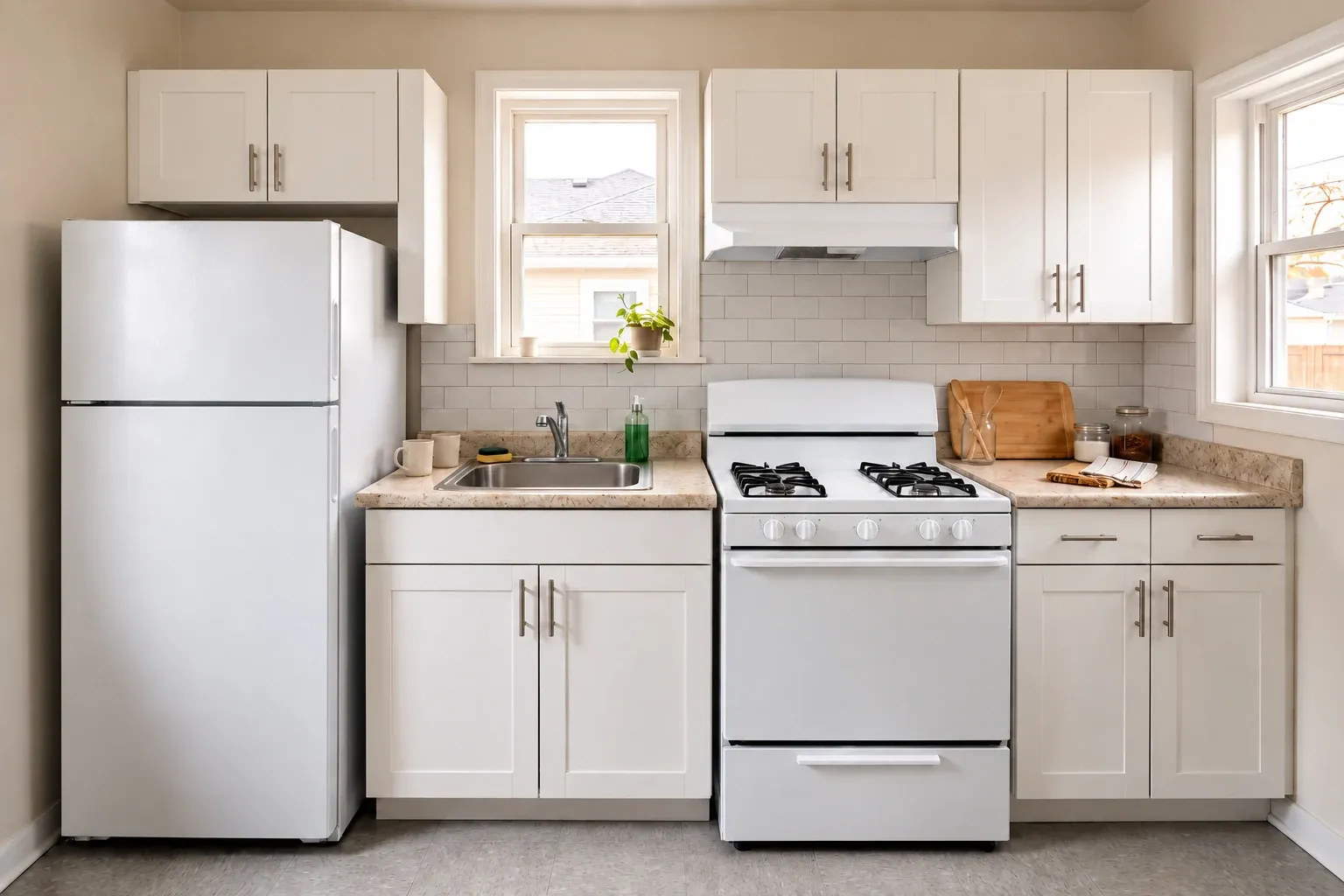
Before comparing appliance models, decide what a replacement must let you do. You might need to store the groceries you normally buy, heat a particular serving dish or wash the dishes left after dinner. Write down that task, including the awkward item you do not want to work around.
Then compare models in this order: installation requirements, everyday access, usable interior and purchase scope. A compact label belongs near the beginning of your search, not at the end of the decision.
Write a requirement that can rule a model out
Name the job and the compromise you would accept. For a refrigerator, that might be keeping your usual shopping pattern while accepting a different shelf arrangement. For a microwave, it might be accommodating your regular reheating dish while giving up a feature you rarely use.
Separate a necessary replacement from an additional countertop appliance. If the appliance would be an addition, name both its job and its intended operating location. Do not make a storage spot stand in for a place to use it.
| Your requirement | What to bring to the comparison |
|---|---|
| Refrigeration for your regular groceries | A list of the containers and groceries that need space together |
| Cooking or reheating a usual meal | The cookware or dish dimensions, the cooking task and the required appliance function |
| Dishwashing after a usual meal | A representative dish list, including serving pieces and cookware you hope to wash |
| An additional countertop function | The task it adds, its operating location and where it would stay between uses |
These are your requirements, not household-size rules. Avoid choosing capacity solely from how many people a product description says an appliance serves.
If the kitchen problem is still unclear, return to the practical small kitchen starting plan before building a shortlist.
Check the permitted installation before the dimensions
A small appliance is not automatically suitable for a cabinet opening. For example, the GE manual linked for its GDE03GGKBB compact refrigerator says not to build it in or install it in a recessed area. That is a restriction for the models covered by that manual, not a rule for all compact refrigerators. GE compact refrigerator manual, installation section.
Microwaves need the same distinction between countertop and permitted built-in use. GE's guidance says to use the trim kit designed for the specific built-in-capable model; the kit provides an airflow arrangement as well as a finished appearance. Do not treat a decorative surround as proof of compatibility. GE built-in trim-kit guidance.
For each candidate, save the exact model identifier and its installation document. Check that the document covers that model and intended configuration. If the retailer's file and the manufacturer's specification disagree, put the candidate on hold until the manufacturer resolves the difference.
Record three kinds of space
Use separate fields for the appliance body, its installation requirements and its open-door use. Do not combine them into one “will fit” box.
| Space to check | What to record | What it answers |
|---|---|---|
| Appliance body | Published dimensions, noting handles, feet or other inclusions stated by the manufacturer | Which physical dimensions are being described? |
| Installation space | The exact opening, ventilation clearances, connection space and permitted configuration in the instructions | Can this model be installed in the proposed location? |
| Everyday access | The specified opening requirements and the surrounding doors, drawers and work areas | Can you use the appliance in the kitchen you are planning? |
Keep the measurement labels and units from the source. Write your own room measurements alongside them, with the location measured. Leave an unknown requirement unresolved rather than supplying a customary allowance.
For example, imagine two hypothetical refrigerator candidates. One appears smaller with its doors closed, but you have not established whether its drawers can be accessed beside your wall. The other has a documented arrangement that you have checked against the space. The first is not yet a confirmed fit, regardless of its smaller body dimensions.
Use checking doors, drawers and everyday access for the surrounding kitchen conflicts. Appliance installation requirements still come from the exact appliance documentation.
Confirm connections before keeping a model on the shortlist
Ask the installer to identify which existing connections meet the candidate's requirements and what would need changing. For cooking appliances, include the proposed power or fuel connection and any specified ventilation arrangement. For water-connected appliances, include the supply and drainage requirements. This is a request for a documented assessment, not a wiring or plumbing exercise.
Countertop equipment can have specific restrictions too. The Danby DDW631SDB manual describes a faucet connection and prohibits extension-cord use. Those instructions belong to that model; a countertop label does not establish that your proposed hookup is suitable. Danby owner’s manual, safety and water-connection sections.
Record an answer as confirmed, change required or not confirmed, and note who supplied it. If the required change is outside the project you are willing to undertake, remove the model from the current shortlist.
When a dishwasher choice raises a faucet or sink change, treat that as a separate compatibility decision. Use sink and faucet upgrade planning for that scope rather than assuming a new fixture will solve the connection question.
Compare the interior with the task you wrote down
Use the same item list for each model. Ask to see the relevant interior arrangement, loading guidance or manufacturer drawing. Record whether an item fit is demonstrated, documented or still unknown.
For a refrigerator, consider the containers you want to store together and how you would retrieve them. For a cooking appliance, check the proposed cookware against the manufacturer's permitted use and interior guidance. For a dishwasher, examine the loading arrangement instead of translating a place-setting count into a promise about your whole dinner cleanup.
Ask about the configuration you would actually use. If a demonstration changes a shelf or rack position, record what that means for the other items on your list. Do not count mutually exclusive arrangements as simultaneous capacity.
A useful hypothetical comparison might read: “Candidate A accommodates the dish in the documented configuration; Candidate B needs confirmation.” That is more actionable than “Candidate A looks roomy.” It is not a cleaning, cooling or cooking performance verdict.
For dishwasher formats and model-specific selection, continue to the compact dishwasher fit and installation guide. Keep this broader comparison focused on which appliance changes belong in your kitchen.
Compare the whole purchase, including unresolved work
Once candidates meet the practical requirements, ask for dated, itemized offers. Use the same requested scope for each: appliance, necessary accessories, delivery, installation, removal and any connection work. Mark an unquoted item “not quoted,” not zero.
Read the applicable warranty separately from an optional protection plan. Record which parts and work are covered, exclusions and who handles a claim. Do not let a warranty headline replace the terms for the actual model and sale.
If you compare energy labels, keep their estimates separate from a prediction of your own bill. ENERGY STAR explains that dishwasher EnergyGuide estimates use assumptions about usage and energy costs. They are not measured results from your kitchen. ENERGY STAR explanation of dishwasher energy metrics.
Use budget small kitchen makeover planning to decide whether the complete appliance scope deserves priority over another improvement.
Make the final comparison on one sheet
Use one column per exact model. Carry forward the evidence you collected rather than starting a fresh list of attractive features.
| Decision field | Candidate A | Candidate B |
|---|---|---|
| Exact model and matching documents | Record the model and documents. | Record the model and documents. |
| Required task and interior arrangement | Describe the task and interior arrangement. | Describe the task and interior arrangement. |
| Permitted installation confirmed | Record the installation confirmation. | Record the installation confirmation. |
| Body, installation space and access checked separately | Record the separate space and access checks. | Record the separate space and access checks. |
| Connections confirmed or changes itemized | Record confirmed connections or required changes. | Record confirmed connections or required changes. |
| Required items fit: evidence or open question | Note fit evidence and open questions. | Note fit evidence and open questions. |
| Features you will use, after essential requirements are met | List the features you expect to use. | List the features you expect to use. |
| Dated complete offer and exclusions | Record the dated offer and exclusions. | Record the dated offer and exclusions. |
| Applicable warranty and service contact | Record the warranty and service contact. | Record the warranty and service contact. |
| Remaining question and person responsible | Name the open question and responsible person. | Name the open question and responsible person. |
Treat installation and connection requirements as conditions, not points that extra features can offset. Among candidates that meet those conditions, choose the tradeoff you can explain: which task it handles, which arrangement you accept and which complete purchase scope you are prepared to take on.