Small Kitchen Ideas: A Practical Starting Plan
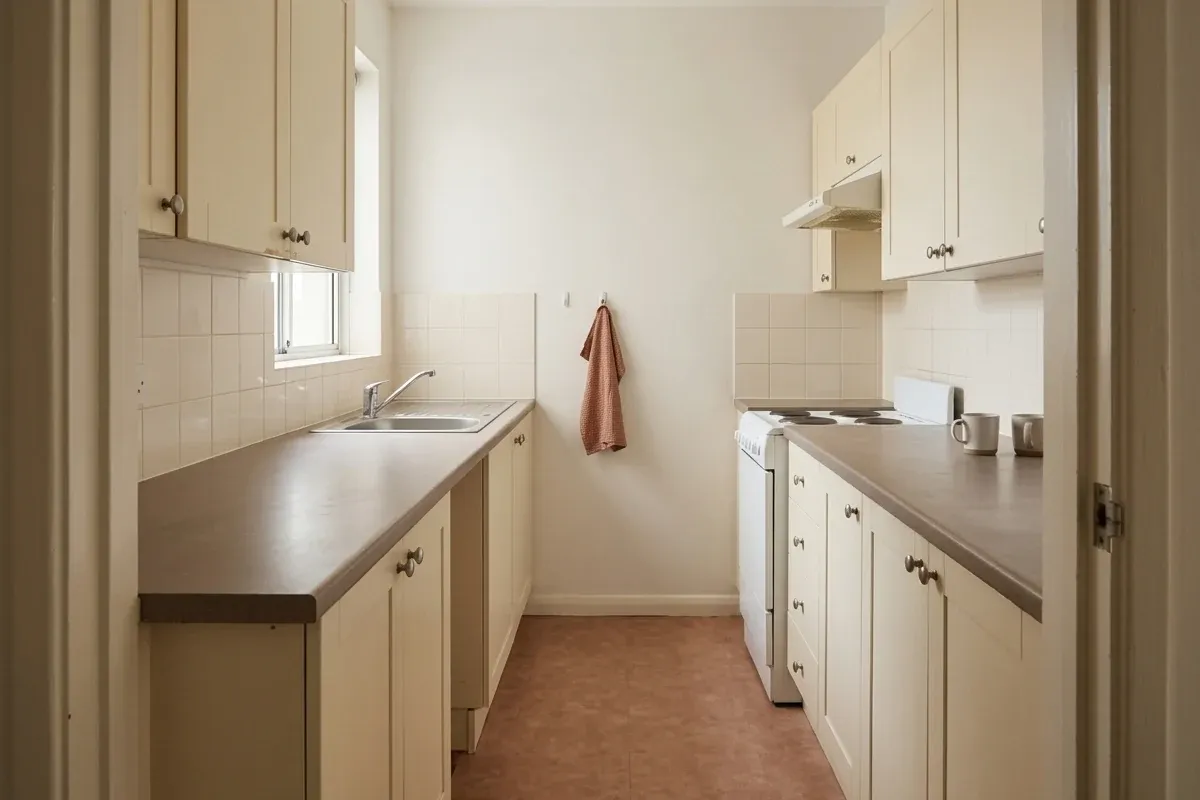
If making lunch starts with finding somewhere to put the cutting board, begin with that problem. A new cabinet color might be appealing, but it answers a different question.
Choose small kitchen ideas around what you want to do more comfortably: prepare a meal, find a pan, put groceries away, or enjoy how the room looks. Then compare the change you have in mind with the space, belongings, and commitments it would involve.
Name the problem before choosing an idea
Think about the last time the kitchen felt awkward. What were you trying to do, and what got in the way?
“There is no room” is difficult to act on. “I move the mail and serving dishes every time I prepare food” gives you something specific to reconsider.
Your starting point might be:
- Too many things occupying the surface you want to use.
- An everyday item that is difficult to retrieve.
- Furniture competing with a cabinet or appliance opening.
- A purchase you want but have no clear place for.
- An appearance you dislike, even though the kitchen works reasonably well.
Choose the problem that matters most to your routine. If appearance is your priority, name that honestly; a decorative change does not have to solve a storage problem to be worth considering.
Match the problem to a useful idea
Give one part of the counter a clear purpose
Choose the area where you would like to prepare food and look at what occupies it. Could the mail belong elsewhere? Could serving pieces you rarely use have a different home?
Start with those ordinary belongings rather than assuming you need another work surface. Decide where each item would go before moving it. A cleared counter is not much help if its contents end up on the table you need for dinner.
Reconsider what gets the easiest storage
If you frequently move seldom-used serving dishes to reach everyday bowls, consider exchanging their storage locations. Choose locations you can comfortably use; do not assume that an empty high shelf is a suitable destination.
Try the idea with existing possessions before selecting an organizer. Record what remains awkward: finding the item, reaching it, or putting it back. Each points toward a different next step.
For a room-wide approach, consider storage across cabinets, counters, and pantry space.
Question a piece of furniture before adding another
Consider a stool used only to hold a bag: finding another home for the bag gives you a reason to question whether the stool needs to stay. A cart used for everyday dishes presents a different choice, because you would also need a plan for its contents. Note the tasks each piece serves and any openings or activities it competes with.
If you are considering an island, write down why: preparation, seating, storage, or something else. Keep the option of no island on your list while you investigate whether one is appropriate.
For that assessment, consider island feasibility and alternatives.
If several parts of the room compete, comparing kitchen layouts is a separate planning task.
Separate a cabinet problem from a storage problem
Before deciding on new cabinets, describe what you want changed. Are the contents difficult to arrange? Does the opening make access awkward? Or do you dislike the cabinet's appearance?
For example, you might like the cabinet fronts but find a drawer awkward to use. That gives you an access question to investigate, without assuming that the whole cabinet needs replacing.
A closer look at cabinet storage, access, and upgrade options can help you frame that decision.
Give a proposed appliance a job and a place
Before adding an appliance to your wish list, name the task you expect it to handle and where you expect to use and store it. Also identify what would leave that space.
For example, if you want an appliance for an occasional baking task, compare keeping your current method with adding something that needs a place between uses. If you cannot identify that place or have not checked the appliance's requirements, leave the purchase undecided.
When you are ready to choose appliances for a small kitchen, use that task and space requirement as your starting point.
Make a visual change that suits your taste
If function is not the main concern, start with what you want to see differently. You might prefer fewer items on an existing display shelf, a different arrangement of favorite dishes, or a coordinated color choice when replacing worn kitchen towels.
Use belongings you already have to explore the look where possible. Judge it by whether you like the result, without expecting a change in color or decoration to create physical storage space.
Record the constraints that could change your choice
Before settling on an idea, note what it must work around:
- Other uses: Who else uses the area, and for what?
- Belongings: Where will anything displaced by the change go?
- Space questions: What opening, item, or available space still needs measuring?
- Permission: If you rent or share the home, what permission or agreement remains unresolved?
- Commitment: What are you willing to spend, alter, and live with while work happens?
Record unknowns as unknowns. A planning note is not confirmation that a product fits or a proposed installation is appropriate.
If there is little room to rearrange anything, focus on what deserves space in a very small kitchen.
Choose a first change you can explain
Compare your possible changes by how directly they address the problem and what they ask of you.
Reassigning ordinary belongings or editing a display can be a low-commitment option. Buying furniture adds a purchase and a placement decision. Altering cabinets, fixtures, or installed appliances belongs in a larger-project category with further research.
Put any option with unresolved requirements in a “research first” group. Among the remaining options, favor one that addresses your chosen frustration and whose effects on the rest of the kitchen you understand.
When spending becomes the decision, prioritize your kitchen makeover budget around the problem you want to address.
Fill in your first-change decision sheet
Use this sheet for one problem. To compare two ideas, make two copies, label them Option A and Option B, and answer every question for each. Then compare the answers side by side.
| Decision | Your notes |
|---|---|
| What task or frustration am I addressing? | Name the task or frustration. |
| Which idea am I considering? | Describe the idea. |
| What would I like it to improve? | State the intended improvement. |
| What would it displace or make less convenient? | Identify the displacement or inconvenience. |
| What constraints or permission questions matter? | List the constraints and permission questions. |
| What do I still need to measure, check, or research? | List the measurements, checks, or research needed. |
| Is this an arrangement, a purchase, or a larger project? | Identify the type of change. |
| What is my next action, including doing nothing for now? | Choose the next action, including no change. |
| What will I look for afterward to decide whether to keep it? | Define what you will observe afterward. |
| Which specialized guide addresses my remaining question? | Identify the guide that addresses the remaining question. |
For a hypothetical example, imagine that serving dishes occupy the counter you want for lunch preparation. Your candidate change is to store them in an existing cabinet. Before acting, check whether they have a usable place there and what would need to move. Your follow-up question could be whether making lunch still requires relocating those dishes. This is a planning example, not a reported result.