Very Small Kitchen Design Ideas: Decide What Deserves the Space
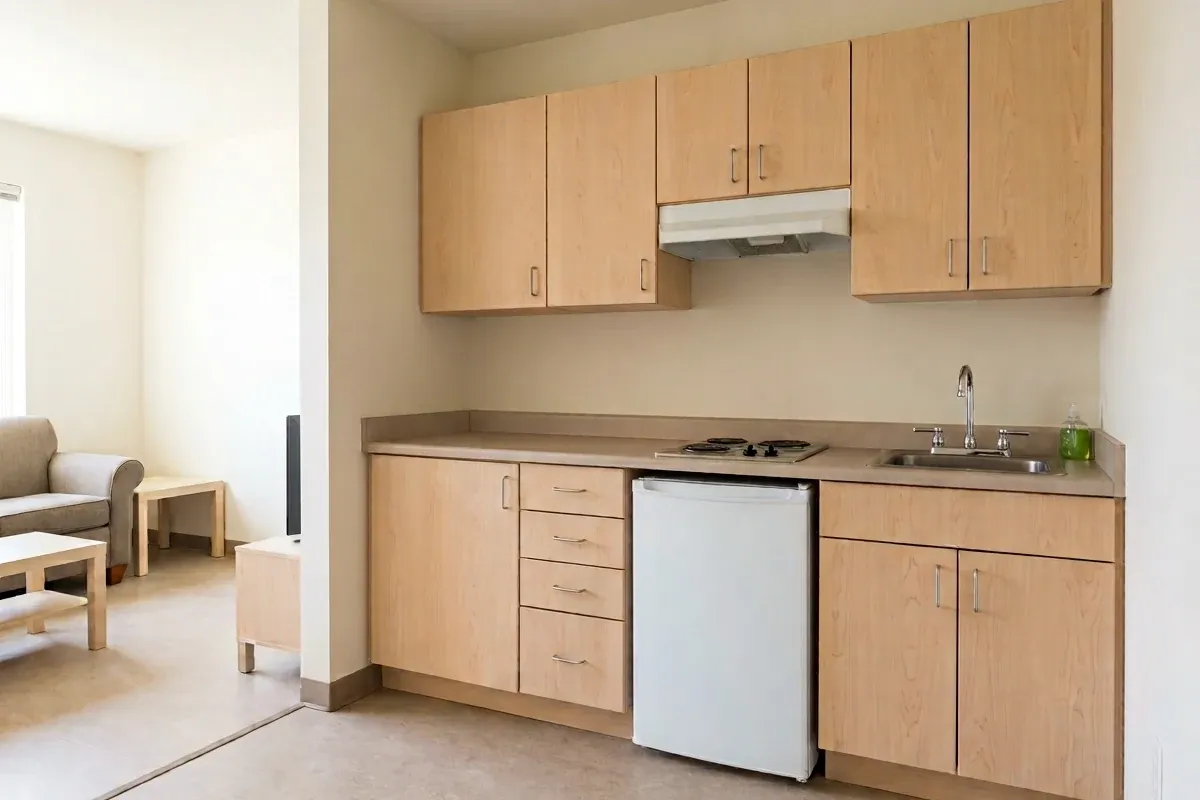
In a very small kitchen, adding one useful thing can remove the place needed for another. A breakfast appliance takes the preparation surface. Extra food occupies the cupboard that held cookware. A dining seat uses the only place to stand while opening a cabinet.
The decision is therefore specific: which functions must work together, which can happen at different times and which can move elsewhere? Here, “very small” describes that competition for space, not a square-footage threshold.
Use a compact home as a reference, not a template
nARCHITECTS describes Carmel Place in Manhattan as apartments ranging from 260 to 360 square feet net. Those are whole-apartment areas, not kitchen measurements. Architect's project account.
The firm's published plan sheet shows several unit arrangements. In the upper-left plan, a compact kitchen sits beside a round dining table in the shared room; other plans arrange living furniture beside similarly concentrated kitchen areas. These are different illustrated units, not a before-and-after transformation. No appliance size, clearance or usable counter dimension is inferred here. nARCHITECTS Carmel Place unit plans.
Our planning inference is that the kitchen's allocation should be considered alongside dining and living functions. Copying the outline alone would miss what the surrounding room contributes. Your home may not have that adjacent space, so any relocation needs a real destination.
Protect one complete cooking sequence
Choose a meal you regularly make. Describe the sequence from taking out ingredients to putting the dishes away. Include the equipment, preparation surface and temporary places for items waiting to be used or washed.
Now identify the moment when the most functions compete. Perhaps the chopping board, countertop appliance and dishes all need the same surface. That moment is more useful to plan around than a photograph of the empty kitchen.
Keep essential functions and any requirements arising from disability, health or dietary needs in the decision. Do not remove equipment simply because a minimalist list treats it as optional.
If you still need to identify the main problem, use a practical starting plan for a small kitchen. The next steps here assume you already know which space is contested.
Decide whether to dedicate, share or release the contested space
Consider a hypothetical kitchen with one usable preparation area. Its owner wants to keep a breakfast appliance there, prepare dinner there and leave washed items there. No dimensions or tested outcome are assumed in this example.
| Choice | What it preserves | What must change for it to work |
|---|---|---|
| Give the appliance a permanent position | Access to a frequently used appliance | Identify a separate suitable preparation area; do not simply assume one exists |
| Store the appliance between uses | The surface can serve other tasks when the appliance is put away | Identify reachable storage and a practical, manufacturer-consistent handling and operating routine |
| Reduce the equipment kept in this kitchen | Releases its storage and operating demands | Decide whether you can accept losing that function or already have another way to perform it |
Frequency alone does not settle the choice. Something used briefly every day may still be difficult to move. Something used less often may be important enough to keep. Record both the benefit and the inconvenience of each option.
For powered equipment, distinguish its stored footprint from the space and conditions required during operation. Check the exact manufacturer's instructions before treating an appliance as something to move between uses or operate elsewhere. Choosing appliances for a small kitchen covers that comparison.
Relocate the function only if the receiving space works
Dining, reserve food and occasional serving pieces do not necessarily need the same location as food preparation. But “put it elsewhere” is not a complete plan.
For dining, identify where the table, seating and people would actually be during a meal. If that room also serves work or rest, decide who moves what and when. Do not count the same area as permanently available to both tasks.
For reserve food, a spare cupboard must meet the food's storage needs. USDA calls for cool, clean, dry storage for shelf-stable food and excludes unsuitable heat, dampness and temperature extremes. Use pantry ideas when there is no separate pantry to assess the location before moving supplies. USDA shelf-stable storage guidance, printed page 14.
For occasional non-food items, name the destination and the retrieval effort. Relocating a serving dish may be acceptable; putting a frequently needed item somewhere you cannot comfortably reach may not be.
Reduce the demand before adding another fixture
When there is no receiving space, look at the quantity or duplication creating the conflict. Compare the cookware needed for the meal you chose with the pieces you habitually keep nearby. Ask whether duplicate functions justify separate items, without assuming one product can replace another's performance.
A hypothetical baking household might keep its mixer and relocate occasional serving ware. A household that seldom bakes might make the opposite choice. Neither is the default answer: the difference is the function each household chooses to preserve.
Before adding furniture, make the existing tradeoff explicit. A new storage position is only a candidate until its fit, use and product requirements are checked. If the proposal changes the arrangement of the room, continue to comparing small kitchen layout approaches.
Write the decision as an exchange
Write down which space you will keep available and what it needs to support. Then identify what will move elsewhere, happen at another time, or leave the kitchen, including a destination for anything you relocate.
Then check the hardest moment in your meal sequence again. Have you preserved the preparation area, accounted for the equipment in use and given displaced items somewhere real to go? If one answer is missing, the exchange is unfinished.
For carrying out a change using existing belongings, follow small kitchen improvements without renovation. Keep your chosen exchange beside the task so an improvement in one area does not quietly create the same problem somewhere else.