Apartment-Size Refrigerators for Small Kitchens: Compare Capacity, Door Clearance & Fit
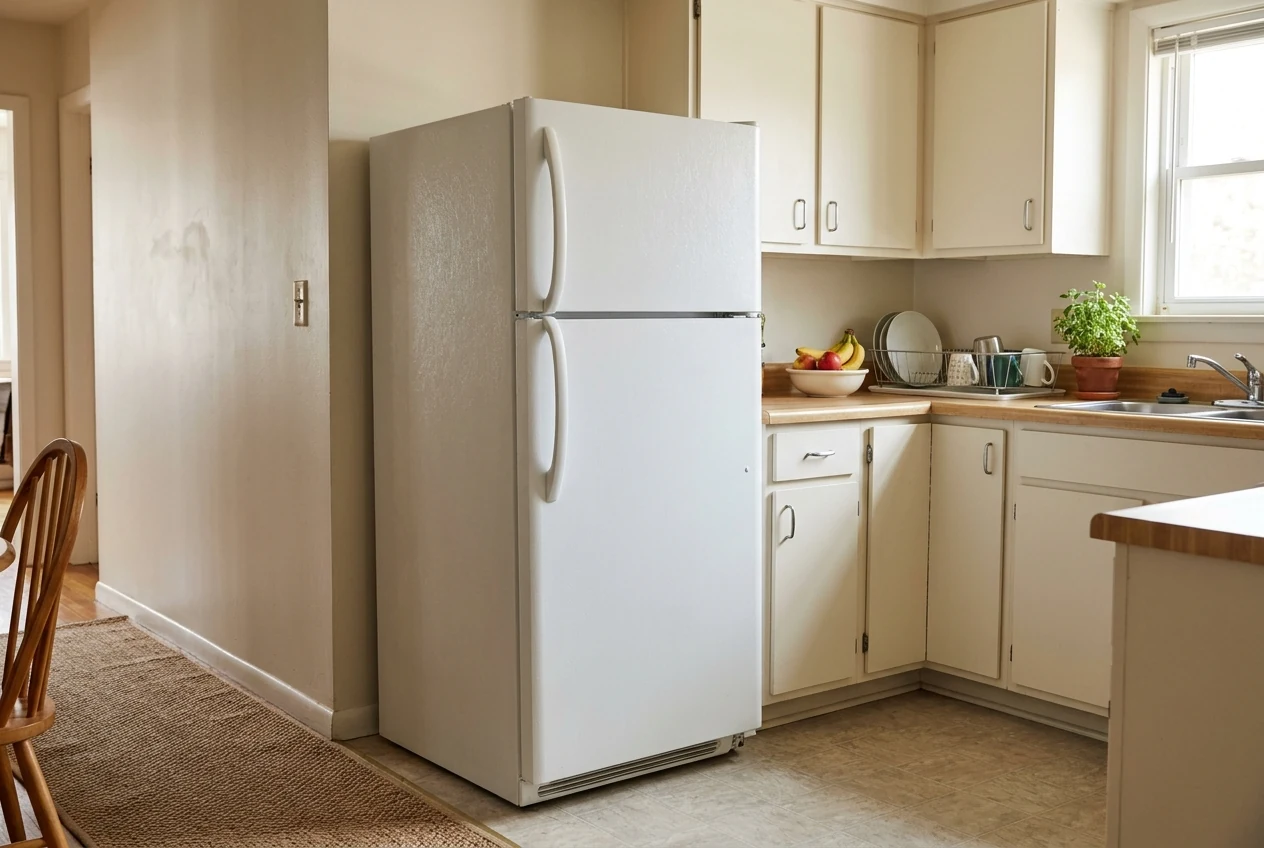
An apartment-size refrigerator needs to accommodate two things: the groceries you buy and the space where you will use it. A larger total capacity can hide a smaller fresh-food compartment. A narrow cabinet can still leave you unable to pull out a crisper beside a wall.
Start by comparing refrigerated and frozen storage separately, then choose the freezer position that suits your routine. Only after that should a candidate move through the three fit checks: its closed size with ventilation, its door swing, and access to extend and remove interior drawers and shelves.
The three examples below use manufacturer documentation, not hands-on testing or product rankings. Neither the grocery scenario nor the kitchen scenario establishes that any named model fits. If you are still deciding which appliance to replace, begin with choosing appliances for a small kitchen.
Compare fresh-food and freezer space separately
Three researched examples and their published capacity splits
Write down both compartment capacities before comparing total volume. The split can change which refrigerator deserves further investigation even when both appear suitable for a small kitchen.
| Researched example | Fresh-food capacity | Freezer capacity | Configuration |
|---|---|---|---|
| Whirlpool WRT112CZJZ | 8.6 cu. ft. | 3.0 cu. ft. | Top freezer |
| Summit FFBF249SS2 | 7.1 cu. ft. | 3.5 cu. ft. | Bottom freezer |
| Summit FFBF279SSX | 10.74 cu. ft. | 3.86 cu. ft. | Bottom freezer |
Manufacturer-published capacities; model names link to official specifications. These examples are not a survey of the whole market or confirmation of local availability.
The FFBF249SS2 lists 0.5 cu. ft. more freezer space than the Whirlpool, but 1.5 cu. ft. less fresh-food space. That is a meaningful tradeoff to investigate if you freeze batch-cooked meals but keep relatively few refrigerated staples. It may be less attractive if produce and leftovers already crowd your refrigerator.
The FFBF279SSX lists more volume in both compartments than either of the other examples. That makes it a capacity comparison point, not an automatic upgrade: its installation and access requirements still need to work at your location. None of these ratings proves that a particular container will pass through a drawer opening or sit on a shelf with the door closed.
Illustrative grocery scenario: check the awkward items first
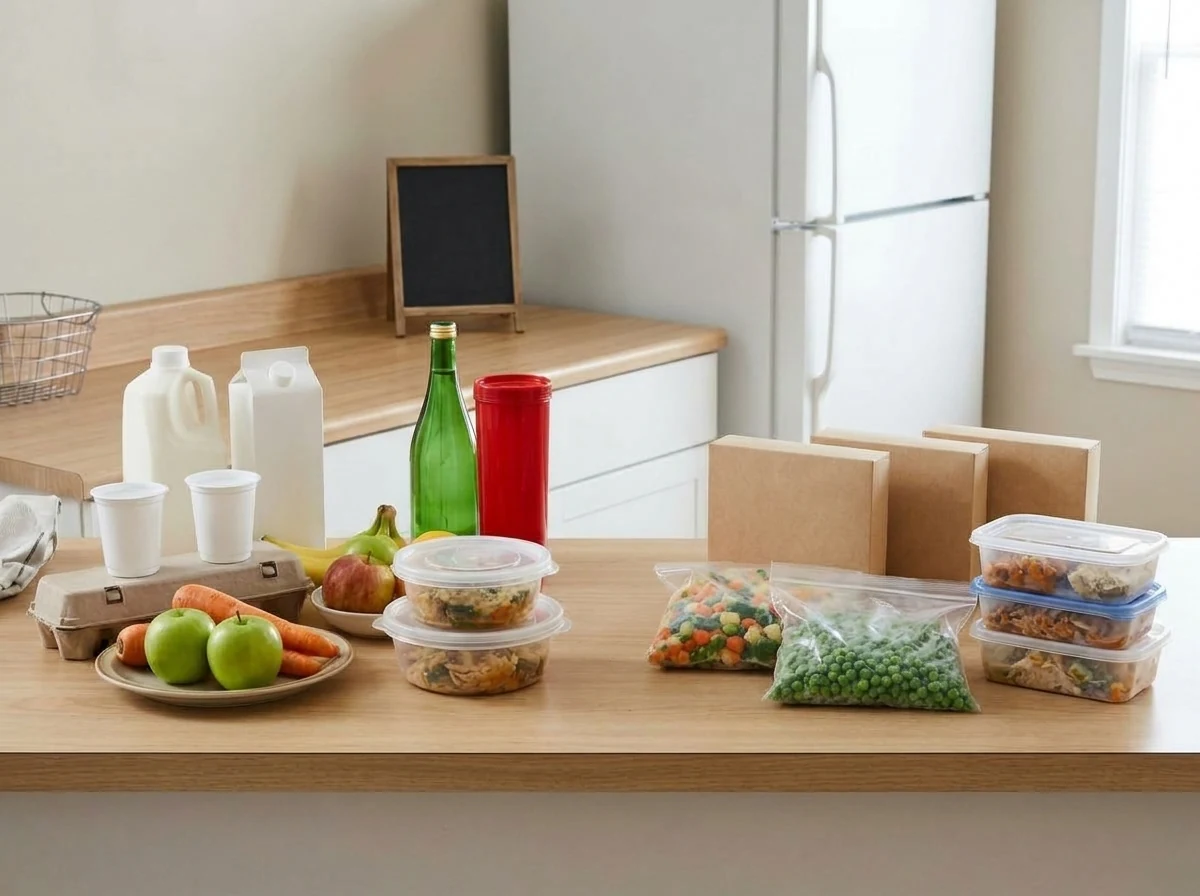
Imagine two adults shopping weekly for a one-gallon milk jug, an egg carton, produce, and condiments. They also want to store four leftover containers measuring 9 × 7 × 3 inches each, six frozen meal portions, and one pizza box measuring 13 × 13 × 1.5 inches.
This is an illustrative shopping list, not a tested load or a capacity recommendation for two people. The meal portions have no assumed package dimensions. Their actual containers would need to be included in the comparison.
| Grocery need | What to confirm inside a candidate |
|---|---|
| Tall milk jug and condiment bottles | Usable height and footprint in the intended shelf or door position, including room for the door to close |
| Produce and egg carton | Space alongside the other refrigerated items, without assuming everything can occupy the same shelf |
| Four leftover containers | A workable arrangement for all four; whether stacking makes the lower containers inconvenient to retrieve |
| Six frozen meal portions | Actual container sizes, usable freezer space, and access to an individual portion |
| Flat pizza box | Clear entry and storage dimensions in its intended orientation, including any drawer front or internal obstruction |
Start with the items you are least willing to change. If the pizza box matters every week, unresolved box fit is a purchasing question even when the freezer rating looks generous. If you routinely refrigerate several prepared meals, compare the leftover containers together with the milk and produce, rather than checking each item in an otherwise empty compartment.
Ask for usable shelf and drawer measurements or examine the exact interior in person. A compartment's published width and depth alone do not establish the entry opening, shelf spacing, or simultaneous arrangement. Keep any unverified item marked “confirm before ordering.”
Choose the freezer configuration around everyday use
A top-freezer layout places frozen storage above refrigerated storage; a bottom-freezer layout reverses that relationship. Consider which foods you retrieve most often and what you can comfortably reach. The useful comparison is your repeated task: lifting out a frozen meal, finding vegetables, or returning a filled leftover container.
| Configuration | Reason to investigate it | Compromise to check |
|---|---|---|
| Top freezer | You prefer frozen food in the upper compartment | Whether the lower fresh-food shelves and crisper are comfortable to use frequently |
| Bottom freezer | You prefer the fresh-food compartment above the freezer | Whether bending to retrieve frozen portions and handling the freezer drawers suits you |
Drawer organization also deserves a closer look. Summit documents three freezer drawers for the FFBF249SS2. Think through separating frozen portions and bulkier packages, but check each drawer's usable shape before assigning food to it. FFBF249SS2 freezer features.
For the FFBF279SSX, the product description and linked manual disagree on the freezer drawer configuration. Confirm the supplied interior with Summit before planning how to divide your groceries; no definitive drawer count is used here. FFBF279SSX description, manual, page 6.
Choose a configuration because its access pattern suits your household. These comparisons do not establish that either format cools better, uses less energy, lasts longer, or offers better value.
Check three different kinds of fit
Assume the refrigerator location is already chosen. For an illustrative example, picture a 30-inch-wide opening with 72 inches to an overhead cabinet, a fixed wall on the right, adjacent counters projecting 25 inches, and an opposite counter face 66 inches from the rear wall.
These are fictional room measurements, not a surveyed installation. They frame three separate questions; they do not establish a fit verdict for any example model.
1. Closed envelope plus ventilation
Compare the applicable refrigerator drawing with the opening, preserving the distinction between the cabinet, doors, handles, and other projections. Then account for the model's installation instructions. The available width or overhead height is not all available for the appliance body.
The documented requirements differ:
- Whirlpool WRT112CZJZ: the August 2021 dimension guide recommends 1/2 inch on each side, calls for 1 1/2 inches above, and at least 1 inch behind. Its fixed-wall hinge allowance is a separate access consideration. W11440351A, page 2.
- Summit FFBF249SS2: the manual specifies freestanding installation, with 50 mm above and behind—approximately 1.97 inches—and adequate side air circulation. Preserve the manual's 50 mm requirement rather than rounding the inch conversion down. This is not approval for a built-in installation. FFBF249SS2 manual, page 6.
- Summit FFBF279SSX: the manual specifies freestanding installation with 2 inches on each side, 2 inches behind, and 4 inches above, plus additional hinge-side space for interior removal. FFBF279SSX manual, page 7.
A nominal “24-inch” label is a size category, not the exact exterior width or the required installation opening. For example, Summit lists FFBF249SS2 at a nominal 24 inches wide but an actual width of 23.38 inches. Use the actual dimensions together with the installation clearances. FFBF249SS2 specifications.
The illustrative 30-inch-wide opening with 72 inches overhead allows two useful screening exclusions:
- FFBF249SS2: its published height to the hinge cap is 73.75 inches. That exceeds the available 72 inches by 1.75 inches, even before adding the required overhead clearance. Summit specifications, installation manual, page 6.
- FFBF279SSX: its published width of 27.63 inches plus 2 inches of required clearance on each side totals 31.63 inches, exceeding the 30-inch width by 1.63 inches. This calculation does not include the additional hinge-side space needed for interior removal, which remains unquantified. Summit specifications, installation manual, page 7.
These published requirements rule out these two candidates at this specific illustrative location; they are not universal judgments about either refrigerator. The example does not authorize built-in installation or establish that any other model fully fits.
Whirlpool dimension conflict: the product page and dimension guide disagree on exterior dimensions. Confirm the applicable dimensions for the specific unit being supplied before ordering or finalizing an opening. No single set of disputed exterior measurements is used in this comparison. Whirlpool specifications, dimension guide.
2. Door swing beside the wall and counters
In the illustrative kitchen, the right-hand wall makes hinge position important. The adjacent 25-inch counter projection also needs to appear beside the refrigerator's hinge and door on the drawing. Check the moving door and its projections through the required opening, not just the final position shown in a sales photograph.
Door handedness is a purchase detail to settle early. Summit's current FFBF249SS2 listing says it ships right-hand unless ordered reversed at the factory and is not user-reversible. Its linked manual includes reversal procedures, so do not plan on reversing it yourself after delivery. Order the desired swing from the factory. Current door-swing listing, linked manual, pages 7–11.
The 66-inch distance to the opposite counter is another input, not a ready-made operating allowance. The refrigerator's installed position, door path, and the place where you stand all affect access. If the problem extends to several doors or work areas, use checking doors, drawers, and everyday access for that broader assessment.
3. Extend and remove the interior drawers and shelves
Opening the outer door is only part of the test. Ask whether you can extend a loaded crisper for everyday use and remove it for cleaning. Check freezer drawers and removable shelves separately. An open-door depth or width does not answer all of those questions.
Whirlpool's cited guide calls for 2 1/4 inches on the hinge side next to a fixed wall and connects that allowance to crisper removal with the door fully open. That is an attributed instruction, not proof of fit for the delivered unit while its applicable dimensions remain unresolved. W11440351A, page 2.
For FFBF249SS2, obtain confirmation of wall-side clearance for full drawer and shelf removal; the reviewed evidence does not establish a conclusive numeric allowance. For FFBF279SSX, the manual explicitly asks for extra hinge-side space beyond its side ventilation allowance, without quantifying that extra space in the text. Neither unknown means zero clearance. FFBF249SS2 installation guidance, pages 6–7, FFBF279SSX installation guidance, page 7.

Turn the comparison into a purchasing shortlist
First, identify the compartment you are most reluctant to compromise. A household storing many refrigerated leftovers should examine fresh-food arrangements closely; one freezing regular batches should scrutinize freezer capacity and container access. Use the published splits to decide what to investigate, then verify the interior arrangement against your actual groceries.
Next, select the freezer position you prefer and screen the remaining candidates at the known location. Separate a documented incompatibility from an unanswered question:
| Shortlist status | What it means | Next action |
|---|---|---|
| Worth further investigation | Capacity split and access pattern suit your priorities | Confirm the container arrangement and all three fit checks |
| Incompatible with this location | Applicable documentation establishes a requirement the location cannot meet | Remove the candidate from this location's shortlist |
| Confirm before ordering | Dimensions conflict, an access allowance is unknown, or the supplied configuration is unclear | Obtain an answer tied to the exact unit; do not mark fit as passed |
Send the seller or manufacturer a concise written request with the exact model, desired hinge side, location sketch, and awkward container sizes. Ask for:
- The installation drawing and revision applicable to the unit being supplied, with closed dimensions and required ventilation identified.
- Confirmation of the ordered door swing and any factory option needed to supply it.
- The supplied shelf and freezer-drawer configuration, with usable openings and dimensions for your largest containers.
- The door position and wall-side space needed to extend and fully remove the crisper, freezer drawers, and shelves.
Keep those answers with the shortlist. A capacity preference can be settled while installation remains pending; it does not need to become a premature purchase decision. Before ordering, the candidate should have both a workable grocery arrangement and documented access at your location. If every option defeats an essential space requirement, revisit what deserves space in a very small kitchen before committing to a different setup.