Dish Racks for Small Kitchens: Countertop vs. Over-the-Sink + Foldaway Options
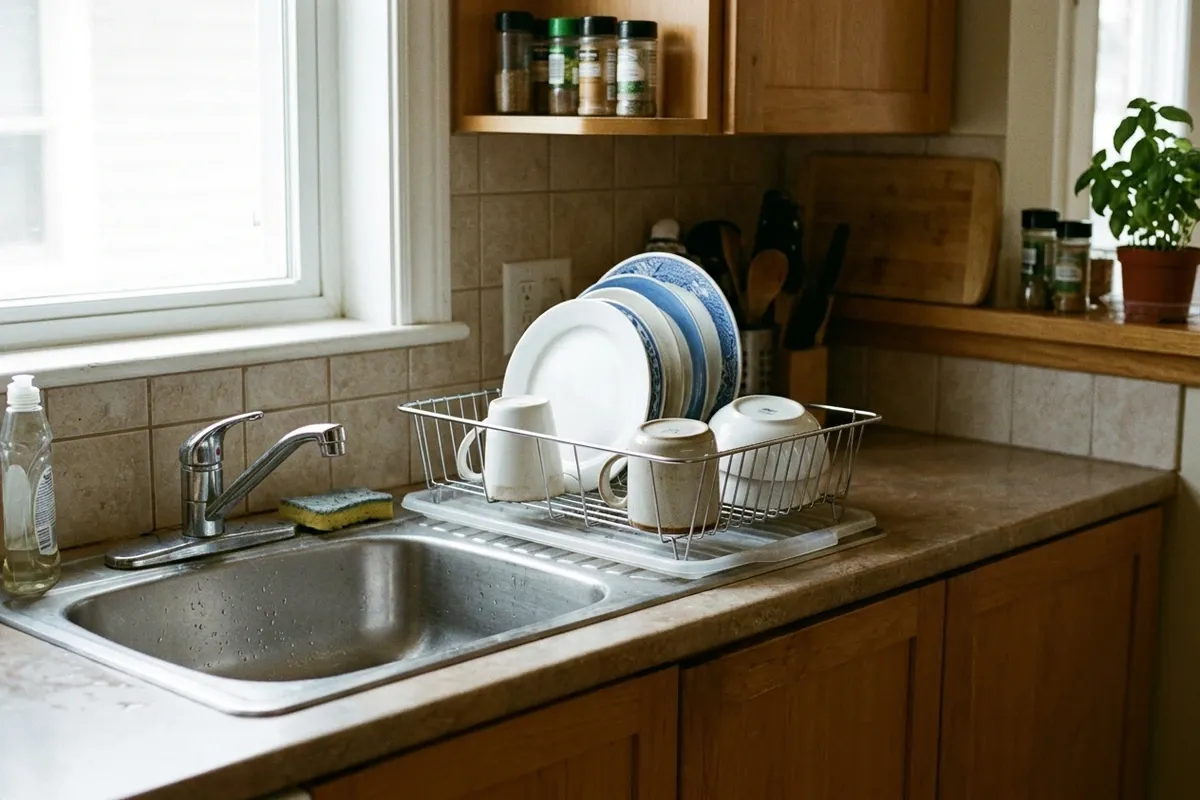
A dish rack can fit beside the sink and still occupy the counter you need for dinner. A rack across the basin can release that counter while getting in the way of washing a pan. Choose between those arrangements by looking at the kitchen while the dishes are wet, then decide where the empty rack will go.
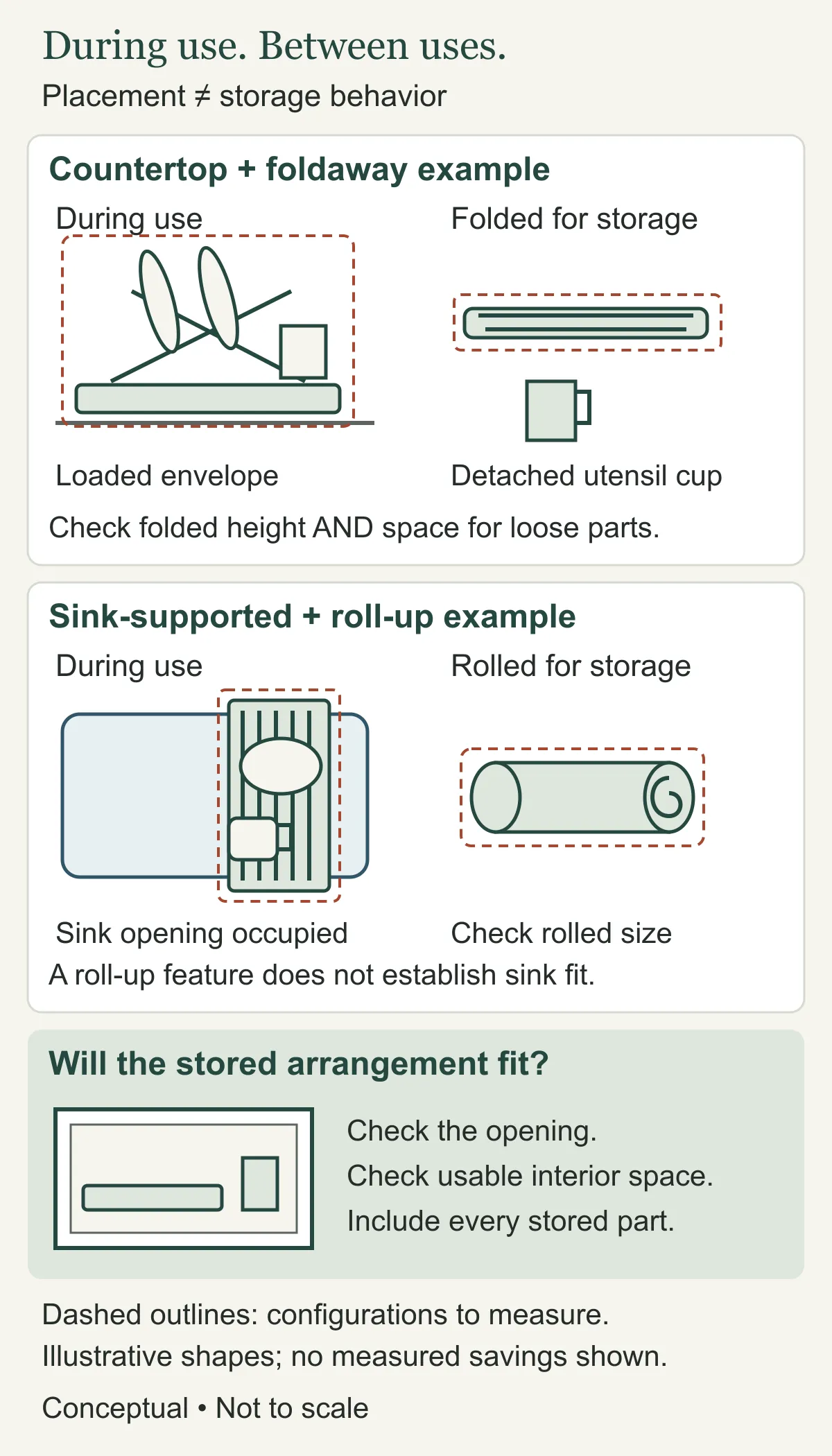
When choosing a dish rack for a small kitchen, separate placement from storage behavior. Countertop and sink-supported describe where it works. Foldaway, fold-flat, and roll-up describe what happens between uses. The examples below illustrate those decisions; they are not product rankings or firsthand tests.
Choose the placement before the folding feature
Start with the space you can spare during cleanup. A countertop rack uses a surface beside the sink. A sink-supported rack spans part of the basin opening on suitable supports. Here, “over-the-sink” means that second arrangement, not tall shelving standing above the faucet, which needs a different clearance assessment.
Either placement still needs a workable drainage arrangement and room for the dishes you intend to load. Folding is a separate consideration: a rack that stores neatly may remain awkward throughout the time it is full.
| Placement | Space committed during use | Check before choosing |
|---|---|---|
| Countertop | Rack, drainage accessories, and loaded dishes beside the sink | Remaining preparation area, drainage route, and access to the faucet |
| Sink-supported | Supported rack and dishes across part of the basin opening | Exact support requirements, remaining sink access, and clearance for the load |
If several belongings are competing for the same surface, begin with small kitchen storage planning. Give the drying arrangement a defined place rather than assuming that a smaller-looking rack will resolve every counter-space conflict.
Compare the space occupied while dishes are wet
Countertop racks use space beside the sink
Think of the wet footprint as the complete area occupied during drying: rack, drainboard or other required accessories, and dishes projecting beyond the edges. The manufacturer's unloaded dimensions are a starting point, not the outline of your finished arrangement.
A pan handle may reach into the preparation area. A utensil holder may sit outside the main basket. A drainage spout may need the rack positioned closer to the basin than you expected. Mark those features separately when comparing an exact model with your counter.
Leave room to reach and remove the items you use. A rack squeezed between the sink and a wall might occupy little spare surface but leave an awkward retrieval path. Consider the loaded arrangement from where you normally stand.
Sink-supported racks occupy part of the basin opening
For a sink-supported option, identify which part of the opening the rack would cover. Then consider the sink tasks you still need to perform while dishes are drying: reaching the faucet, rinsing an item, or washing your usual pan.
The counter beside the sink may become available, but that does not mean the kitchen gains unrestricted working space. The drying load has moved into another useful location. If you would need to unload the rack whenever you use the basin, decide whether that routine is acceptable before buying.
Compare both arrangements during the same point in your evening, rather than comparing an empty sink-supported rack with a full countertop one.
Also check the transition between washing and preparing the next meal. If you need the counter before the dishes are ready to put away, identify where that drying load would remain. Moving it temporarily is only a workable plan when the receiving location and handling suit the actual rack and dishes.
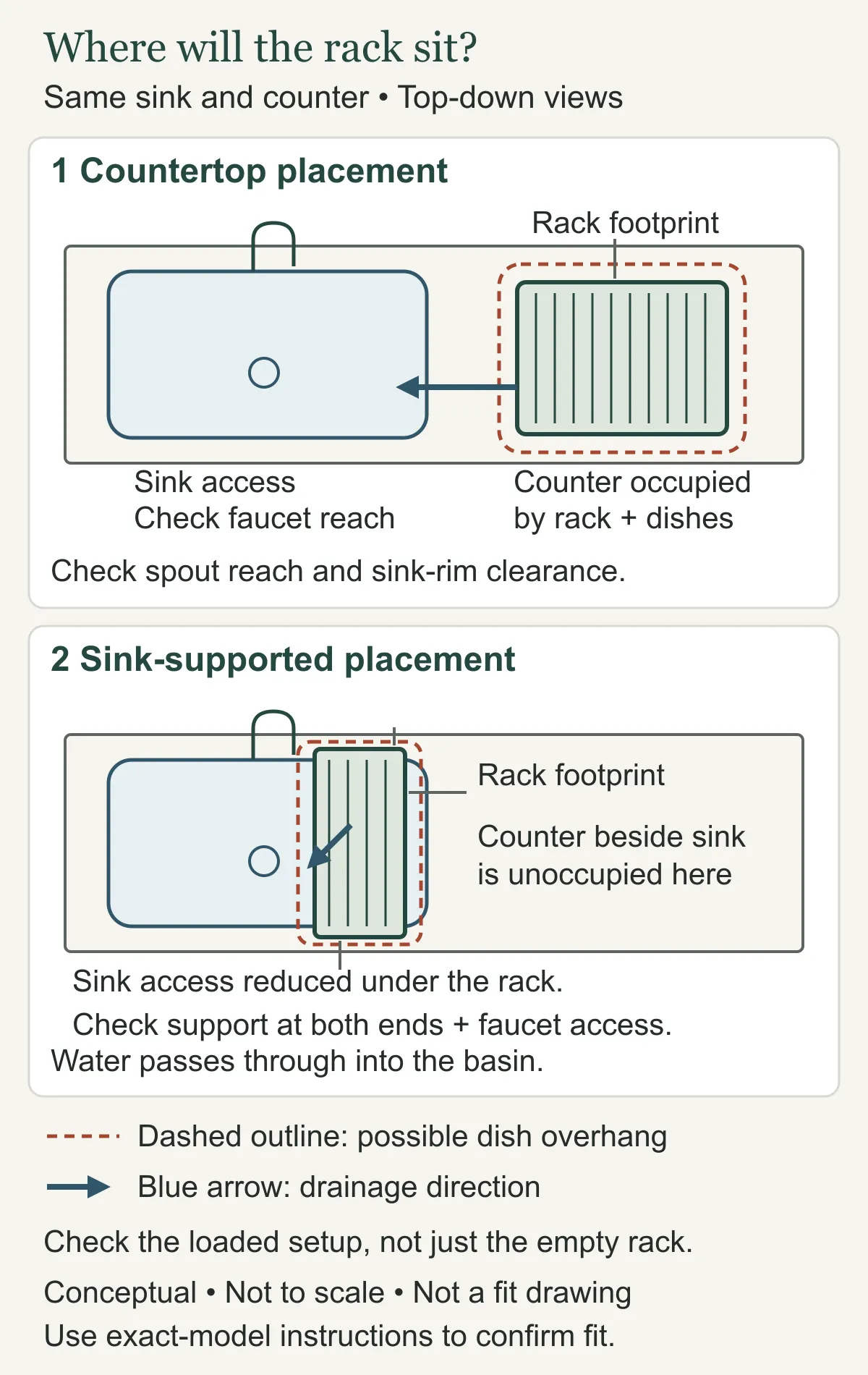
Check fit and follow the drainage path
Record the usable counter surface, sink opening, rim or supporting ledges, and nearby faucet controls. Match those observations to the exact rack's instructions. Overall rack length alone does not establish a compatible sink span or the support overlap required at either end.
For a countertop rack, follow the water route from the tray to its destination. Check whether the product uses a sink-directed spout or another arrangement, and whether the proposed position allows that arrangement to work as documented. A photograph of a rack beside a different sink cannot confirm your fit.
The simplehuman Compact Steel Frame Dishrack, brushed SKU KT1184DC, illustrates a documented spout arrangement: its product page describes a swivel spout directing water into the sink and removal for cleaning. That feature still needs checking against your sink rim and intended position. It is not a promise that every orientation will work in your kitchen. Manufacturer product information.
For a sink-supported example, KOHLER's K-28929-CHR roll-up rack has nominal dimensions of 19½ by 11 inches and a thickness of 5/16 inch. Its specification identifies it as included with K-31465-2AC and K-31466-2AC sinks; it does not establish universal compatibility. Confirm support for your particular sink rather than treating the overall length as a maximum opening size. Kohler specification sheet.
If the purchase leads you to consider replacing fixtures, treat sink and faucet compatibility checks as a separate project. A drying accessory should first be assessed against the sink you intend to keep.
Compare racks with the dishes you actually wash
Write down a familiar handwashing load, including the awkward item that prompted the search. It might contain dinner plates, mugs, a mixing bowl, utensils, and a pan lid. This is your comparison load, not a capacity claim for any rack.
Check how each candidate supports those items and whether one arrangement displaces another. A space used for upright plates may not also accommodate the bowl you want to put there. A photograph showing several small cups does not establish room for your larger mugs.
OXO's Good Grips Foldaway Dish Rack, SKU 1473480, provides a useful configuration example. Its plate rack folds down to accommodate larger items. Consider what that change means for the plates you would otherwise place upright; do not count both configurations as simultaneous capacity. OXO Foldaway details.
Include retrieval in the comparison. Identify the item you would remove first and whether something unrelated must move before it comes out. Leave uncertain accommodation marked unconfirmed rather than assuming that “compact” or a household-size description settles the question.
If your underlying goal is to stop washing the main load by hand, comparing compact dishwasher formats is a different buying decision. Keep this rack comparison focused on the items that need a drying place.
Does folding make the rack easier to store?
Name the intended storage location before paying for a folding feature. Check its opening as well as the interior, and include the tray, utensil holder, and any other parts stored separately. A folded rack that fits inside a cupboard may still be awkward to pass through its opening.
OXO lists the Foldaway rack's open dimensions as 19.4 × 15.5 × 5.125 inches and its closed dimensions as 19.4 × 12.5 × 3.875 inches. Those figures show that closing it does not shorten every dimension: the first listed measurement stays the same. Preserve the manufacturer's measurement order when recording them. OXO published dimensions.
The Good Grips Aluminum Fold Flat Dish Rack illustrates another storage behavior. OXO documents a folding frame, use as a flat drying board, and a removable utensil cup that can sit on either side. Its US page lists unpackaged dimensions of 16.4 × 14.6 inches but does not separately dimension the upright and stored configurations. Confirm the complete folded arrangement, including the cup, before treating it as a verified fit. OXO Aluminum Fold Flat details.
A roll-up design needs the same check. Kohler documents rolling storage for K-28929, but the reviewed specification does not provide rolled dimensions. Check those before allocating a narrow storage slot.
Finally, consider whether you will actually put the rack away. If dishes remain on it between meals, a folding feature may rarely release its working position. Giving everyday items a useful home can help with returning dry dishes to storage.
Check what comes apart for cleaning
Look for instructions that explain how to reach the tray, drainage outlet, joints, and utensil holder. A removable component can provide access, but removal alone does not establish dishwasher suitability or how easily the whole rack cleans.
The simplehuman product page's care FAQ generally advises against putting dishrack parts in the dishwasher unless they are explicitly identified as dishwasher-safe. Kohler's K-28929 specification explicitly lists dishwasher safety for that rack. These are product-specific statements; neither establishes a rule for every steel, silicone, folding, or roll-up design. simplehuman care guidance, Kohler rack specification.
Keep the care instructions with the model information you collect. If they leave a component's cleaning method unclear, ask the manufacturer rather than transferring directions from a similar-looking rack. Consider whether the documented cleaning and reassembly routine is one you are willing to follow. This comparison does not establish which model dries faster or requires the least upkeep.
Before choosing, check where you would set any detached parts during cleaning and how they return to the assembled rack. Include those parts in your storage plan rather than treating them as space-free extras.
Compare the options—including your current setup
Use your existing arrangement as the baseline. Record what you know from using it, then distinguish documented facts from open questions for each proposed purchase. Keep dimensions, support requirements, and accessories tied to the exact model and version.
| Decision field | Current setup | Candidate A | Candidate B |
|---|---|---|---|
| Placement and exact model | Record | Record | Record |
| Published dimensions and configuration | Record | Verify | Verify |
| Wet footprint with your usual dishes | Observe | Check | Check |
| Awkward item and retrieval path | Observe | Confirm | Confirm |
| Sink and faucet access remaining | Observe | Check | Check |
| Drainage route and accessories | Record | Verify | Verify |
| Stored size, loose parts, and destination | Record | Confirm | Confirm |
| Cleaning access and care instructions | Record | Verify | Verify |
| Complete purchase and open questions | Record | Itemize | Itemize |
“Not confirmed” is a useful answer. Do not replace it with an estimated fit or assume an accessory is included because it appears in a photograph. Check the package contents and any additional items required for the arrangement you plan to use.
Keep the current setup if a new rack would merely shift the obstruction from the counter to the basin, or if its stored configuration has no workable home. A purchase deserves consideration when it resolves a specific inconvenience without creating another you are unwilling to accept.
Before ordering, write down where the rack will stand, what it needs to hold, where the water will drain, which sink or counter areas must remain accessible, and where the rack will stay between uses. Add any unresolved fit or care question alongside those notes. You then have a concrete arrangement to verify, rather than a compact-looking product without a place to work.