Framed vs. Frameless Cabinets for a Small Kitchen: What to Compare Before Choosing
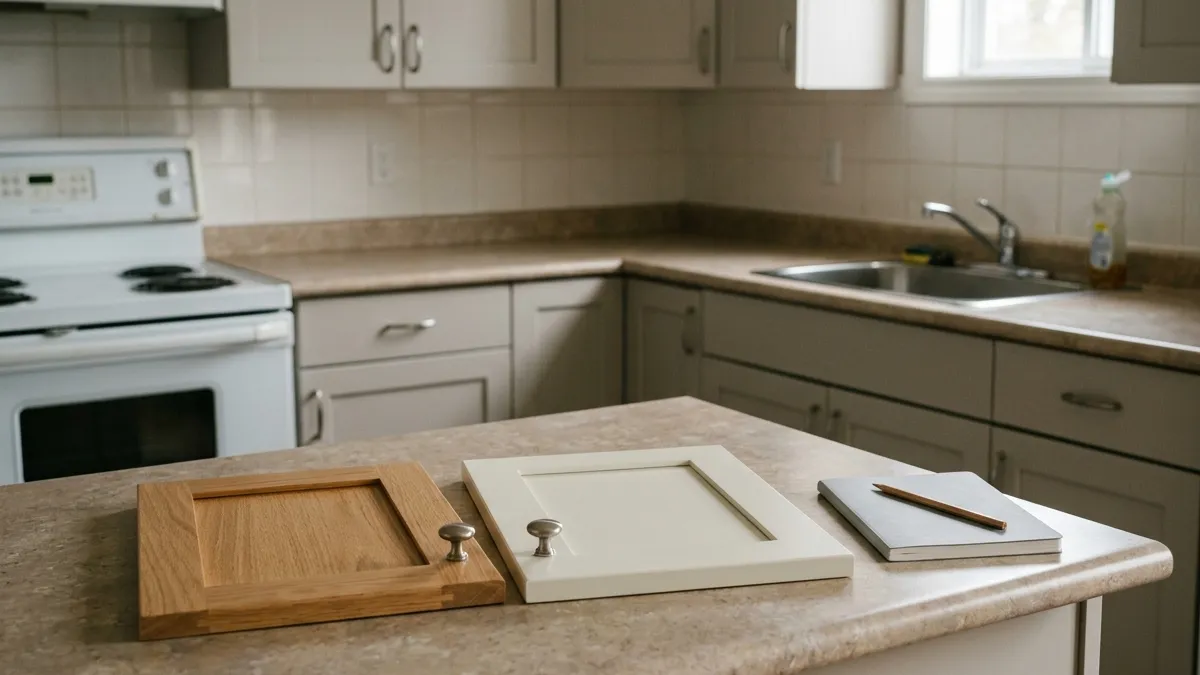
When comparing framed and frameless kitchen cabinets, start with an open cabinet, not just a door sample. The construction affects the front opening and hardware arrangement, but the label alone does not tell you how much cookware the cabinets will hold, what the installed kitchen will cost, or how well the cabinets will serve you.
For a small kitchen, the useful comparison is between specific cabinets doing the same job. Ask each supplier to show the opening, interior dimensions, door operation, and complete specification. If you are still deciding what the cabinets need to do, begin with planning small kitchen cabinets.
What framed and frameless actually mean
Framed: a face frame across the cabinet front
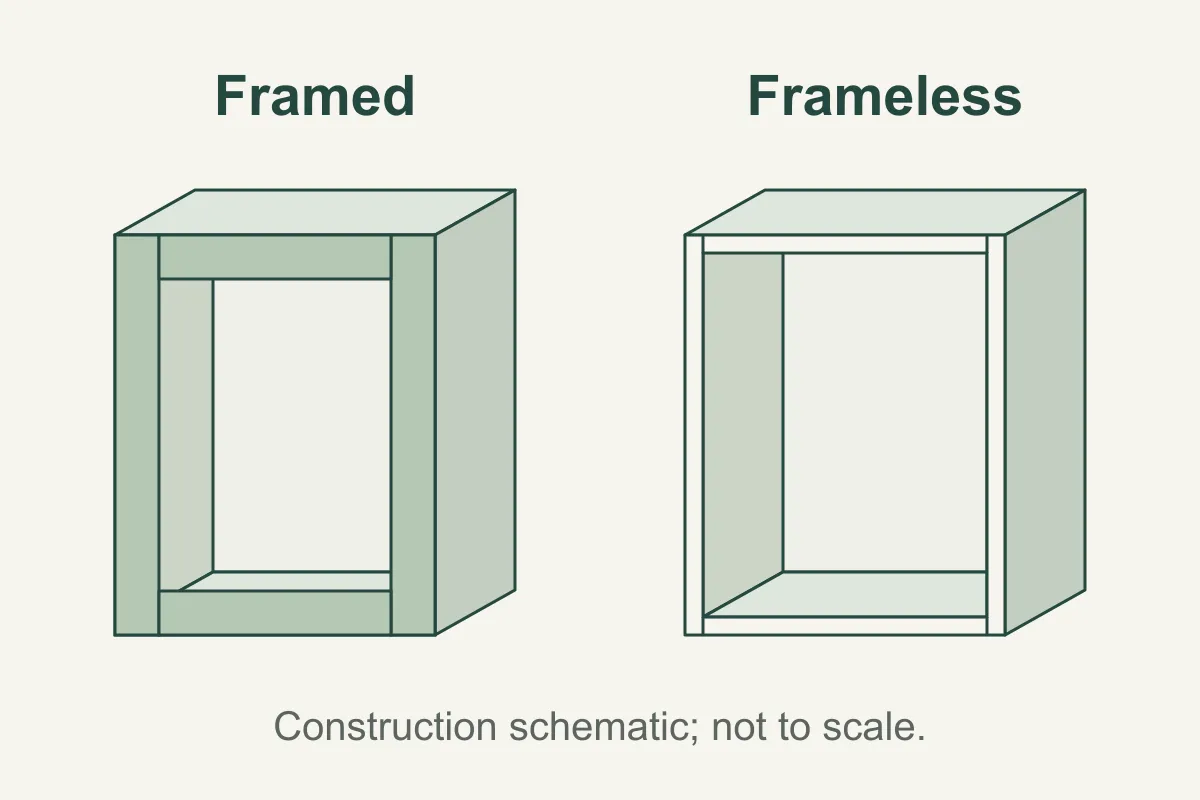
A framed cabinet has a face frame attached across the front of its box. This is part of the cabinet construction, distinct from any decorative frame around a door panel. Kitchen Craft describes framed construction as having a front frame to which the door hinges attach. Exact hinge arrangements vary by system.
Look at the cabinet with its doors open. Identify the box sides and the frame in front of them. Ask the supplier to identify any center member in that particular cabinet rather than assuming every framed configuration has one.
Frameless: a cabinet box without that face frame
A frameless cabinet omits the front face frame. You may also see it described as “full access.” Kitchen Craft uses both terms and describes hinges attaching to the inside walls of the cabinet box.
“Full access” describes the construction approach; it is not a promise that every item will pass through the opening. The doors, hinges, and specified interior still need to work together. Compare the actual cabinet rather than treating the name as a capacity rating.
Compare the opening separately from the storage inside
Where the face frame affects access
The face frame occupies space at the front opening. Kitchen Craft identifies removing that obstruction as an access benefit of its full-access construction. That can matter when you are trying to get a wide item into or out of a cabinet.
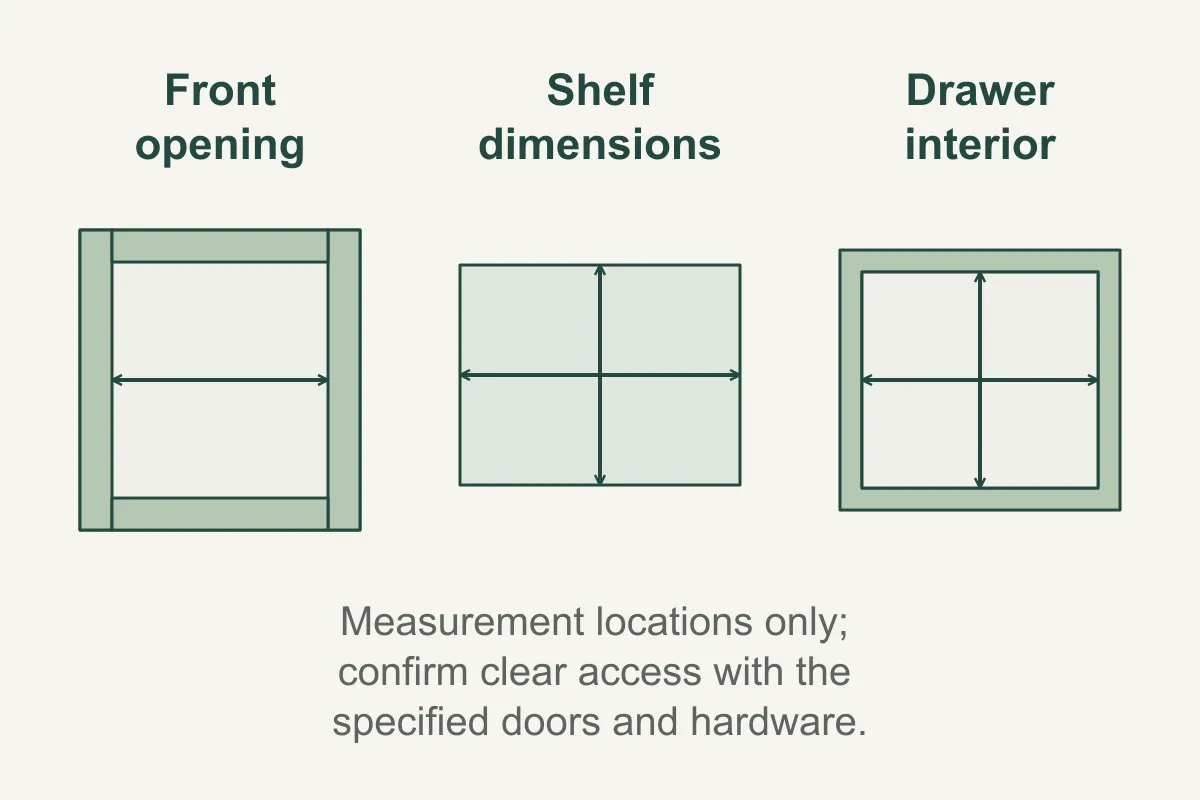
But the opening and the space behind it are different measurements. A shelf may have room for a mixing bowl that is awkward to maneuver through the front. Conversely, a generous opening does not establish the width or depth of a drawer inside.
Kitchen Craft also describes drawer-space benefits for its full-access cabinets. Treat that as a reason to compare dimensions, not a universal percentage gain. No single storage increase applies to every framed-versus-frameless proposal.
What to request for two comparable cabinets
Choose one cabinet from each proposal with the same exterior dimensions and intended job. Request the clear opening with the specified doors open, usable shelf dimensions, and actual drawer interior dimensions where relevant. Ask the supplier to identify any hardware or divider that affects the usable space.
Bring the dimensions of an awkward item you own, including handles. Ask for a demonstration or a dimensioned drawing showing how it enters and sits inside. For detailed help checking usable cabinet space, record the opening and interior separately before considering organizers.
Keep the comparison fair: a shelf cabinet and a drawer stack answer different storage needs even when their exterior widths match.
Separate construction from door appearance
Full overlay is not another name for frameless. Dura Supreme provides full-overlay door adjustment guides for both framed and frameless cabinetry. A closed-door photograph therefore cannot establish whether a face frame is present.
Door profile and finish are separate choices too. Dura Supreme describes its frameless Bria line as offering styles from traditional to contemporary. Frameless construction does not restrict that range to plain slab doors, although availability must be checked within the line you are considering.
Ask for construction, door profile, overlay or inset arrangement, and finish to be listed separately. View the proposed fronts together so you can judge their appearance without confusing it with the cabinet box behind them.
Check the hinge system and future replacement parts
The broad distinction is frame mounting versus cabinet-side mounting, but it does not identify the correct replacement hinge. Blum's CLIP top range can serve face-frame and frameless applications through appropriate mounting plates. Its COMPACT CLIP range is specifically designed for face-frame cabinets and includes concealed hinges with integrated soft-close.
Neither a concealed hinge nor soft-close operation is exclusive to frameless construction. Likewise, “European hinge” is not enough information to establish compatibility.
Request the hinge and mounting-plate identifiers, where a separate plate is used, plus confirmation that the combination suits the specified door and application. Have the supplier confirm the required opening behavior rather than selecting a similar-looking hinge yourself.
For future service, ask who supplies replacement hinges and fronts and what order details you should retain. Blum documents clip-on door removal and adjustment for CLIP top, but that feature does not guarantee a replacement door will fit. Front dimensions, hinge preparation, and finish availability still need confirmation. There is no basis here for declaring either construction universally easier to repair.
Ask how installation and alignment will be handled
Both constructions need careful alignment. Dura Supreme's framed and frameless installation guides warn that forcing cabinets against crooked walls or into out-of-square corners can rack the cabinets and misalign their doors.
The joining details also differ in those guides: Dura Supreme describes connections through face-frame stiles for its framed cabinets and through cabinet sides for its frameless cabinets. These are manufacturer-specific examples, not instructions to copy for another brand.
Ask the installer which instructions govern the proposed line, how site irregularities will be accommodated, and who handles final door and drawer adjustments. Keep that work in the written scope. The construction label alone does not establish installation difficulty or labor cost.
Compare quality evidence and complete quotes
KCMA states that both framed and frameless cabinets are eligible for ANSI/KCMA A161.1 quality certification. Ask whether the particular product line is certified. Eligibility is not proof that every cabinet carrying the same construction label has passed testing, nor does certification establish a winner between the two systems.
Request the specified box materials, hardware, applicable warranty, and service contact. Read the actual warranty terms and exclusions; a warranty title is not a measured lifespan. Keep replacement-part availability as a supplier question unless you have written confirmation.
Use this table to organize the comparison. Dimensions and commercial terms belong to the products being quoted.
| Framed | Frameless | What to verify on your proposal |
|---|---|---|
| Construction: face frame across the box front | Construction: no front face frame | Exact cabinet line and construction specification |
| Opening: frame occupies space at the front | Opening: no face-frame obstruction | Clear opening with the specified doors and hardware |
| Interior: dimensions depend on the cabinet and fittings | Interior: dimensions depend on the cabinet and fittings | Shelf dimensions and usable drawer interiors for matching exterior sizes |
| Hinges: face-frame applications require compatible hardware | Hinges: cabinet-side applications require compatible hardware | Exact hinge, mounting arrangement, and door compatibility |
| Appearance: full-overlay options exist | Appearance: full-overlay options exist | Available door profile, finish, and front arrangement |
| Installation: follow the line's instructions | Installation: follow the line's instructions | Site preparation, alignment, and final adjustment responsibilities |
| Quality and support: product-specific | Quality and support: product-specific | Certification, warranty terms, and replacement-part support |
| Price: obtain an itemized quote | Price: obtain an itemized quote | Equivalent cabinet schedule, options, delivery, installation, and exclusions |
Do not compare headline totals until the scope matches. A different drawer arrangement, finish, or installation allowance means you are comparing more than construction. Ask suppliers to identify those differences rather than attributing the entire price gap to the face frame.
If retaining your current cabinet boxes remains an option, return to comparing cabinet refresh and replacement. Choosing new construction is a different decision from choosing new fronts for existing boxes.
Choose the proposal that answers your small-kitchen requirements
Use a short checklist before accepting either proposal:
- The opening accommodates the items assigned to that cabinet.
- Shelf and drawer dimensions are documented separately.
- The door appearance and compatible hinge system are specified.
- Installation and final adjustments have a named responsible party.
- Quality evidence, warranty terms, and parts support have been checked.
- The quotes cover equivalent work, with unresolved items clearly marked.
Frameless may be the more useful choice when its verified opening or interior arrangement solves your particular storage problem. A framed proposal may meet the same requirements with the appearance, support, and scope you prefer. Record the reason for your choice in terms of those confirmed features, leaving any unanswered question open until the supplier resolves it.
Frequently asked questions
Do frameless cabinets actually give me more usable space?
They can provide an access advantage by omitting the face frame, and particular designs may offer more drawer space. Compare clear openings and actual interiors for equivalent cabinets. Do not assume a fixed percentage increase or that every frameless cabinet holds more.
Is full-overlay cabinetry the same as frameless cabinetry?
No. Full overlay describes the front arrangement, while framed or frameless describes cabinet construction. Dura Supreme offers full-overlay guidance for both systems. Ask for the construction specification rather than identifying it from closed doors.
Can framed cabinets have concealed or soft-close hinges?
Yes. Blum's COMPACT CLIP is one manufacturer example of a concealed face-frame hinge with integrated soft-close. Confirm what is included in your cabinet proposal; the example does not establish compatibility with every framed cabinet.
Does frameless construction limit my door-style choices?
It does not inherently mean slab doors only. Dura Supreme's Bria range includes traditional through contemporary styling. Your actual choices depend on the manufacturer's line, so check the desired profile and finish before committing.
What should I confirm about replacement hinges and doors before ordering?
Request hardware identifiers, front specifications, and a supplier contact for replacements. Ask how replacement compatibility and finish availability will be checked. Do not assume a similar hinge or a same-width door will fit the existing preparation.
How can I compare framed and frameless cabinet quotes fairly?
Give suppliers the same cabinet schedule and requested features. Compare dimensions, interiors, fronts, hardware, delivery, installation, and exclusions. Have each supplier explain differences in scope before using the totals to choose between proposals.