Pull-Out Cabinet Organizers for Small Kitchens: Compare Retrofit Options Before Buying
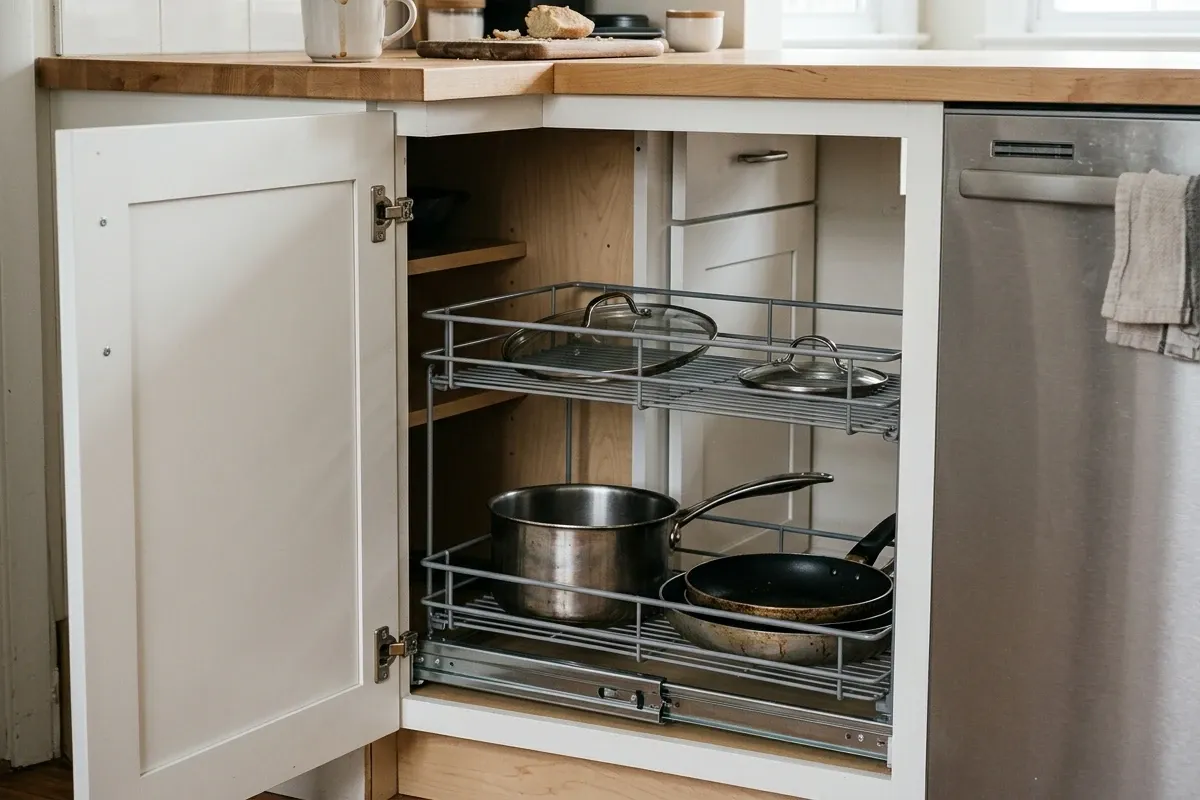
A pull-out can bring a pan at the back of a cabinet closer to your hand. It also puts a basket or drawer, slides, and supports into the space where your cookware already lives. In a small kitchen, that exchange deserves a closer look before you order.
Compare pull-out cabinet organizers by what becomes easier to retrieve, what still fits, and what the installation requires. A second tier or a wider basket is useful only when it works with your belongings and the cabinet you have.
This guide compares ready-made organizers for existing straight base cabinets, usually with the hinged doors kept in place. The named products illustrate design differences; they are not recommendations or firsthand tests. If you are still assigning belongings to cabinets, begin with a small kitchen storage plan.
Compare four pull-out formats for an existing base cabinet
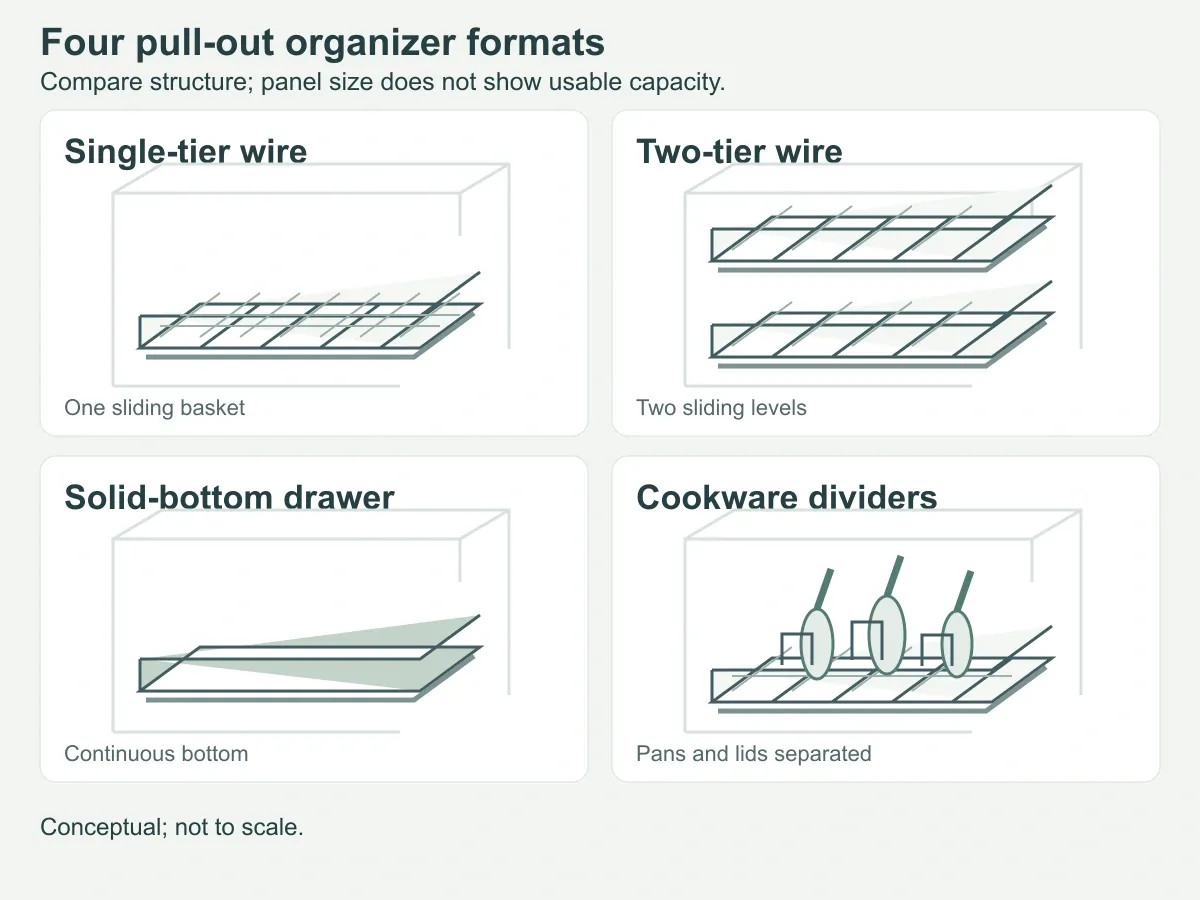
Single-tier wire pull-outs
A single wire basket is worth considering when one group needs to come forward together. Think of the pans you want to retrieve from a deep lower shelf, including the space their handles occupy.
Rev-A-Shelf's 5WB1-1520CR-1 is a floor-mounted example. Its installation instructions show attachment at the front and rear of the assembly to the cabinet floor. Allow for the basket sides as well as the items inside; the product's overall width is not a promise about the flat space available for a pan. Manufacturer installation instructions.
Two-tier wire pull-outs
Two tiers divide items between two levels, provided each group fits the available height. A stockpot that works on the cabinet floor might not work beneath an upper basket.
The Rev-A-Shelf 5WB2-1222CR-1 has an upper basket with three installation-height options. Its instructions also flag possible interference between tall contents and an existing cabinet shelf. Check the proposed loaded arrangement at the selected position rather than treating two baskets as an automatic capacity improvement. Manufacturer two-tier instructions.
Solid-bottom roll-outs and drawers
A solid-bottom drawer gives its contents a continuous supporting surface. Compare that with the wire spacing of a basket, especially for items with small bases. The drawer's sides and hardware still take up part of the cabinet interior.
Rev-A-Shelf's 4WDB-12SC-1 belongs to its wood pull-out drawer range with BLUM soft-close slides. For a small kitchen, the useful questions are the inside dimensions and whether you can remove your largest item without unloading its neighbors. A soft-close feature does not answer either question. Manufacturer drawer range.
Cookware pull-outs with dedicated dividers
A cookware-specific arrangement may suit a collection whose lids and pans are awkward to separate. It also commits space to those particular shapes, so check your own cookware rather than counting the pieces in a product photograph.
Rev-A-Shelf's 5CW2-1222-CR uses independently operating tiers, with lid storage above and adjustable pan dividers below. Compare the largest lid knob, longest handle, and widest pan against the intended positions. The dividers have value only if the pieces you use can enter and leave those positions. Manufacturer cookware specification sheet.
Match the exact organizer to your cabinet
Separate minimum opening from overall and usable dimensions
Bring your existing cabinet record to the shortlist. If you do not have one, use cabinet storage ideas based on usable space for the opening, interior, and obstruction checks.
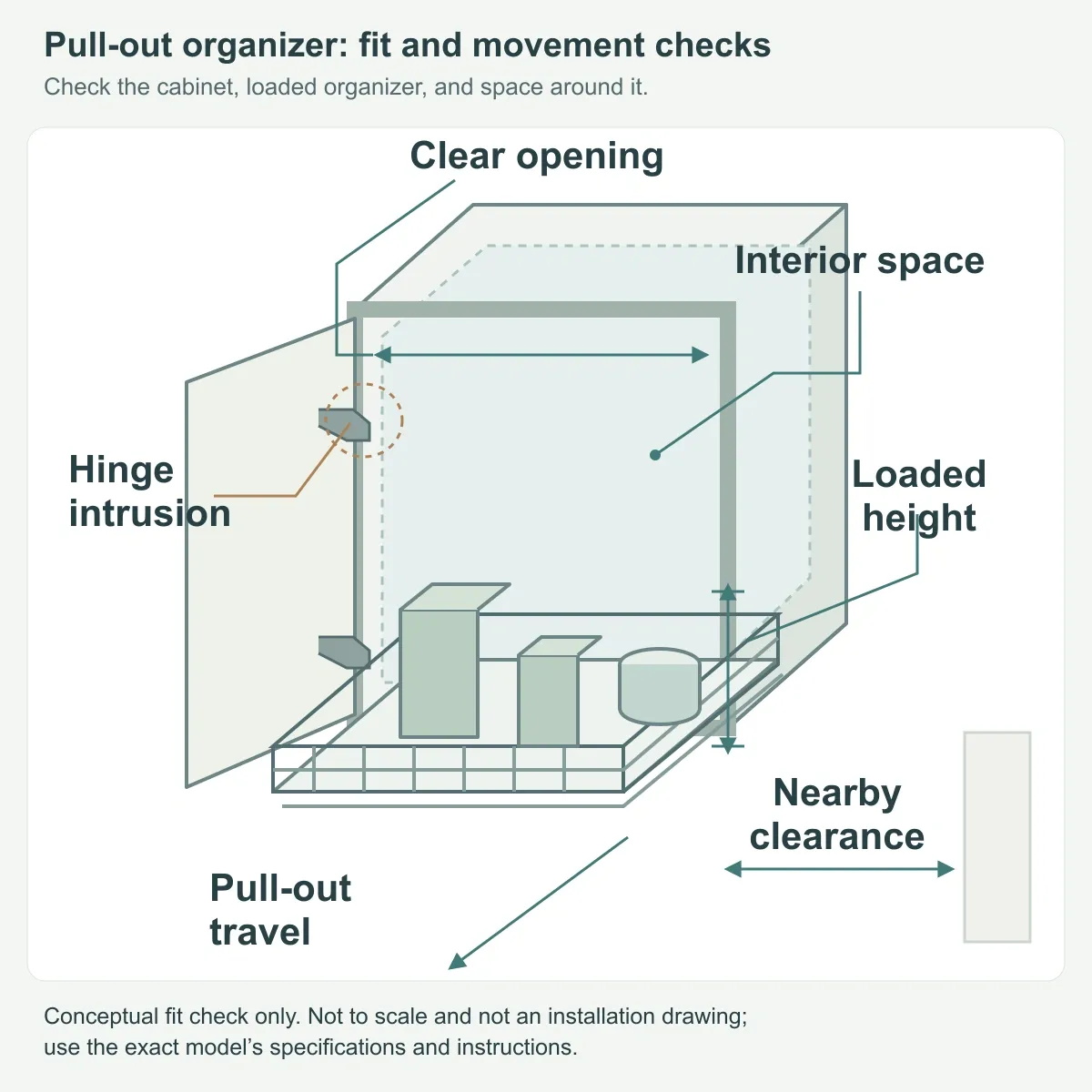
Keep three entries separate: the manufacturer's minimum opening, the complete assembly dimensions, and the usable basket or drawer interior. A nominal cabinet-size label cannot substitute for those entries. Nor should an overall product dimension become an internal storage measurement because the latter is missing.
Match the specification to the exact model number and cabinet application. If you need help identifying your cabinet construction, see framed versus frameless cabinets. Leave an undocumented inside dimension unanswered until the supplier confirms it.
Check hinges, doors, existing shelves, and loaded height
Follow the proposed movement with the contents included. The basket must pass the hinges and open door; a pan handle or lid may project beyond the basket. Check the underside of any drawer above and any shelf you intend to retain.
Use the door position you can actually achieve in your kitchen. A nearby wall or handle may limit it.
Confirm every required mounting surface
Read where the complete unit attaches before accepting “bottom-mounted” as sufficient information. The 5WB2 instructions require floor fastening, an attachment to the face frame or frameless side wall, and rear sockets. Its floor supports do not replace those other connections. Manufacturer mounting requirements.
Check that each required location is accessible and suitable. Pipes, brackets, or damaged panels can rule out a candidate. If the cabinet's material or condition leaves fastening uncertain, ask the supplier or installer to assess it before buying.
Compare the access gained with the storage space used
Check extension and the path of the items you remove
Extension describes slide travel; it does not confirm that you can lift your largest item out. Check where the organizer stops, which contents remain beneath a shelf, and where you will stand.
The exact 5WB1-1520CR-1 drawing specifies full-extension ball-bearing slides with normal closing. That is evidence for this model, not every wire pull-out. Manufacturer model drawing.
In a narrow kitchen, include nearby moving fronts in the check. Use these small-kitchen door, drawer, and access checks if the extended organizer competes with an appliance door or your standing space.
Compare the same contents in each format
Compare every candidate using the same item list, and note anything displaced; another cupboard may not have room for it.
| Format | Potential access benefit | Main space tradeoff | Installation question to verify |
|---|---|---|---|
| Single-tier wire | Can bring one group forward together | Basket sides and slides occupy space around the contents | Can the cabinet accept the model's required mounting points? |
| Two-tier wire | Can separate contents between two accessible levels | The upper basket and supports limit available height | Where must the supports attach, and which tier position clears existing shelves? |
| Solid-bottom roll-out / drawer | Can bring items forward on a continuous supporting surface | Drawer sides and hardware reduce the space available inside | Does the mounting platform meet the selected drawer's instructions? |
| Cookware-specific pull-out | Can make individual lids and pans easier to retrieve | Dividers reserve space for particular cookware shapes | Can the required supports fit without obstructing the loaded tiers? |
For example, separating lids may make them easier to find while leaving no workable position for a stockpot. That is a tradeoff to resolve, not evidence that the organizer holds more.
Read load ratings without assuming a per-tier allowance
Record what the rating describes: slides, a basket, or the complete organizer. If that distinction is absent, ask for clarification. Do not multiply an ambiguous figure by the number of tiers.
Include all the items you intend to store when assessing the load. A partly filled display photograph says little about your cookware collection. The cabinet's mounting surfaces also need to suit the installation; a slide specification cannot establish the strength of an unknown shelf or cabinet floor.
Check installation, cleaning, and removal requirements
Check the work needed to prepare the mounting platform
Review how you will reach the required mounting surfaces and position the assembly. Identify any preparation needed before fastening it in place, and include that work in your installation plan.
The 4WDB drawer instructions place the slide set on the cabinet floor. They also state that, if installed on a shelf, that shelf must be secured to the cabinet to prevent tipping when the unit is pulled out. Do not assume a loose adjustable shelf is an acceptable mounting platform. Manufacturer drawer instructions.
Check release mechanisms and permitted cleaning
Consider how you will reach crumbs, corners, and the cabinet surface beneath the organizer. A continuous bottom and an open wire basket present different cleaning tasks; appearance alone does not establish which will suit you.
The 5WB2 instructions describe releasing the baskets from their slides and re-engaging them carefully. That procedure is not a claim that a loaded basket is intended to be carried around the kitchen. The reviewed instructions specify damp-cloth cleaning followed by drying. They do not establish suitability for soaking or dishwasher cleaning. Manufacturer removal and care instructions.
Decide whether the installation suits your cabinet and skills
Before ordering, identify the work you would perform: assembling supports, positioning slides, reaching fastening points, and checking alignment. Decide whether you are comfortable completing those tasks to the manufacturer's instructions or need an installation quote.
Keep changes to the cabinet explicit. If a shelf obstructs the proposed unit, establish whether it can appropriately be removed; do not assume it is expendable. In a rental, obtain permission for the intended fastening or alterations before treating that organizer as an available option.
Compare the complete purchase before ordering
Verify included slides, brackets, and fasteners
Match the seller's listing to the manufacturer's exact model number, then check the package contents against the instructions. Establish whether the offer includes the complete organizer and mounting system or only a component.
Add any required compatible parts, supplies, tools you do not own, delivery, tax, and paid installation to the purchase total. Keep cabinet preparation separate if its scope is uncertain. A lower item price does not settle the comparison when one candidate requires additional work.
Separate required accessories from optional door mounting
With your hinged door retained, you open the door and then pull the organizer forward. Attaching the cabinet front to a compatible organizer is a different installation decision.
The 5WB1 instructions identify door-mount hardware as separately sold. Do not count it as a required purchase for the basic installation, or assume a kit advertised for another organizer will fit. If door mounting interests you, request confirmation for both the exact organizer and existing front. Manufacturer accessory note.
Resolve missing or conflicting specifications
When dimensions or features disagree, keep the candidate unconfirmed. Request the current drawing and instructions for the exact model number, including its closing mechanism and cabinet application. Do not choose the smaller opening figure simply because it would make the product fit.
Save the confirmed specification with your order details. Before checkout, make sure the selected size and version match it. If a seller cannot clarify a requirement that determines fit, leave that product off the shortlist.
Choose the format that solves your retrieval problem
When one tier is enough
Consider a single-tier format when it brings the intended group forward, accommodates the items you need, and leaves a workable arrangement above. Compare wire and solid bottoms around those contents and your cleaning preferences.
When a second tier or cookware divider earns its space
Consider a second tier when both loaded levels work beneath the cabinet's obstructions. Consider cookware dividers when their positions suit your actual lids and pans. Require a clear retrieval benefit rather than an extra shelf or feature on the specification list.
When keeping the existing shelf is the better choice
Keep the shelf if the proposed organizer displaces necessary cookware, creates a clearance conflict, or requires work you cannot justify. You do not need to fill an awkward cabinet with a product that introduces another problem.
Before buying, identify what the organizer will make easier to retrieve, which items will remain in the cabinet, and what installation requires. If any of those details remains unconfirmed, the purchase is not ready.