Lazy Susan vs. Blind-Corner Pull-Out: Check Your Corner Cabinet Before Buying
When comparing a Lazy Susan with a blind-corner pull-out, start by opening the cabinet. Its shape, door arrangement and available movement space may make one type worth considering and rule another out. Neither is an automatic upgrade for every corner.
Rotating shelves bring different parts of a tray toward the opening. Blind-corner mechanisms address storage hidden to one side of it. Half-moon organizers complicate the comparison because some pivot and slide, and manufacturers may also classify them as Lazy Susans.
The useful choice is the mechanism that fits your particular cabinet and makes the items you need easier to retrieve. This guide explains what to identify, measure and confirm before ordering for an existing base corner cabinet. Product examples illustrate categories and documented requirements; they are not firsthand tests or fit recommendations.
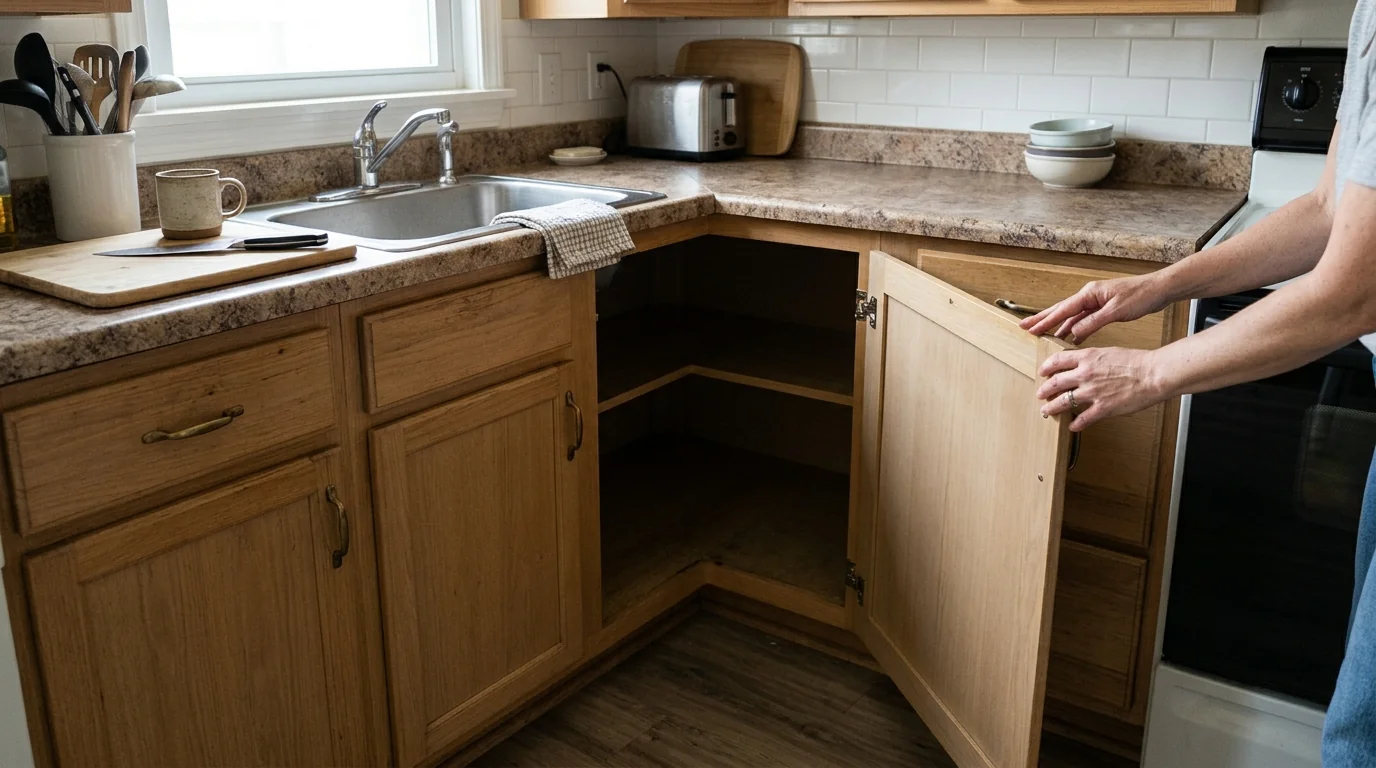
Identify your corner cabinet and door arrangement
Look at the opening and the space behind it together. Supplier names can vary, so include a sketch or photographs when asking about compatibility.
| What you see | Configuration to identify | First question |
|---|---|---|
| A front opening that cuts diagonally across the corner | Diagonal-front corner cabinet | What is the interior shape behind that opening? |
| Two front faces meeting at the inside corner | Right-angle corner, sometimes described as easy-reach | Do the doors hinge open separately from the organizer, or move with it? |
| One opening with storage extending sideways behind the adjoining run | Blind-corner cabinet | Which side is hidden, and how much usable space extends into it? |
| An enclosed corner with no usable opening | Inaccessible corner void | Would creating access require cabinet work? |
For a right-angle corner, examine the doors closely. They may fold together on hinges, or the fronts may belong to an attached-door rotating system. Those arrangements place different demands on a replacement. Rev-A-Shelf's Lazy Susan application guide distinguishes diagonal and angled corners, including an attached-door pie-cut application.
Keep an existing-cabinet retrofit separate from choosing a new corner cabinet. If you are replacing the box, you can discuss the opening and interior together with the supplier. Use planning small kitchen cabinets for that broader specification. If the cabinet turns out to be a straight base cabinet, continue to pull-out organizers for straight base cabinets.
Compare the movements, not just the product labels
Full-circle, kidney and pie-cut rotating shelves
A full-circle tray has a circular outline; a kidney-shaped tray has a cutaway. A pie-cut design is another rotating family, with attached-door applications that need to be distinguished from shelves behind separately hinged doors. D-shaped trays add a straight edge to the range of shapes.
Shape does not identify the whole installation. Rev-A-Shelf's guide also distinguishes bearing and post hardware, bottom mounting and telescoping supports, and shelves that rotate together or independently. Check the particular system rather than assuming every Lazy Susan has a central pole or the same door relationship.
For two named examples, Rev-A-Shelf lists 6472-28-11-52 in its kidney-shaped two-shelf range and 6942-28-11-52 in its pie-cut two-shelf range. Those listings establish their categories. They do not establish either model's compatibility with your doors or cabinet. Obtain the current instructions for the exact identifier before treating it as a candidate to buy.
Half-moon organizers: pivoting and sliding
A half-moon is relevant when investigating a blind corner. Rev-A-Shelf's half-moon category includes a polymer pivot-and-slide family as well as other half-moon offerings. Do not assume every product bearing that shape has the same movement or hardware.
Ask the supplier to show how the selected shelf moves from its stored position to the opening. A product called a Lazy Susan can still be a blind-corner solution; the name alone does not tell you whether it rotates inside, pivots outward or also slides.
Blind-corner optimizers and other pull-out systems
Blind-corner systems use their own arrangements of carriers, slides, supports and trays. Compare the actual operation rather than treating all “corner pull-outs” as interchangeable.
Rev-A-Shelf describes its 53PSPE Elite optimizer series as non-handed, with upper shelves that slide independently from lower shelves. Its installation instructions still distinguish the two cabinet orientations. Those are specific design features, not a promise that the system suits every blind corner.
Swing-out tray systems are another family to investigate. Their fit requirements must come from their own drawings; a clearance or movement shown for one system cannot be transferred to another.
Measure the opening, interior and full movement path
Make a sketch with the accessible opening and hidden side clearly labeled. Photograph the cabinet empty enough to show its construction, without removing fixed parts. Record where each measurement begins and ends, and leave anything you cannot reach marked unknown.
Separate the clear opening from the space behind it
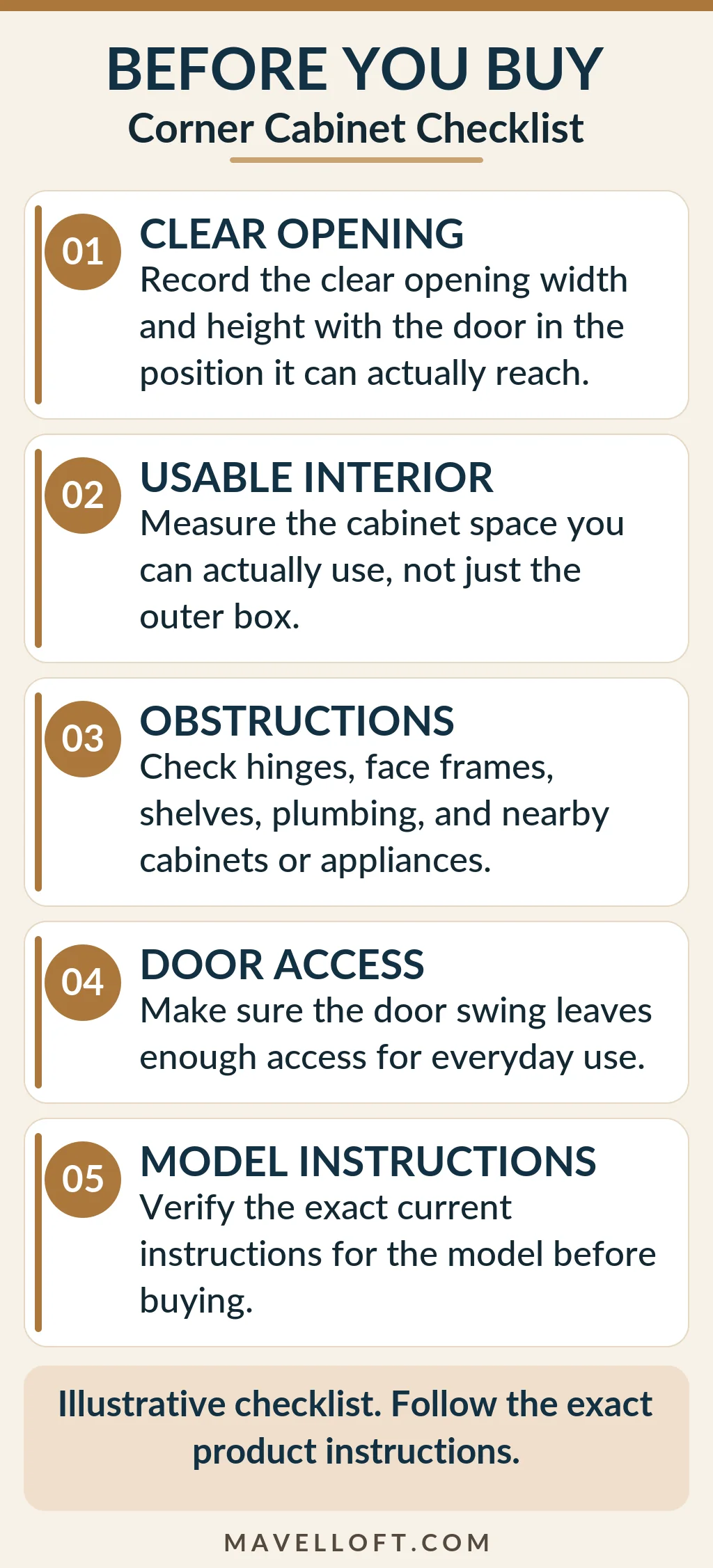
Record the clear opening width and height with the door in the position it can actually reach. Note the frame opening and any door or hinge projection separately, including restrictions at the heights where the proposed organizer would pass.
Then record usable interior width, depth and height. In a blind corner, the interior width extends beyond the visible opening into the hidden section. For depth, identify the front reference point you used; the inside of a face frame and the front of the cabinet box are different starting points. For height, account for the underside of any drawer, shelf or top obstruction.
A manufacturer's “minimum cabinet opening” figure is only part of the fit information. Match each dimension to the exact drawing's reference points. Do not use a product's overall width as its opening requirement, or assume that matching the opening width proves there is enough room inside.
Record the restrictions that matter at a corner
| Check | What to record for the supplier |
|---|---|
| Face frame and reinforcement | Projecting rails, stiles, bottom lip and internal supports |
| Hinges and doors | Hinge bodies and plates, door thickness, open position and any projection into the opening |
| Hidden interior | Usable width and depth behind the blind front, including fixed obstructions |
| Vertical space | Available height at the proposed supports and trays, plus the height of intended contents |
| Neighboring fronts | Handles, drawers, appliances or walls that restrict the door or proposed organizer |
| Services and fixed parts | Pipes, cables, shelves or other objects occupying mounting or moving space |
If you cannot identify the construction, use framed versus frameless cabinets to understand the distinction. The construction label helps select the right drawing; it does not confirm fit by itself.
Check the journey as well as the parked position
An organizer can fit inside while closed and still meet an obstruction during use. Request the selected model's movement drawing or a demonstration that shows the intermediate positions as well as the fully open position. Compare that information with your cabinet and adjacent fronts.
Include the space where you would stand to retrieve a pan. A tray extending into the room is useful only if you can reach and lift its contents there. For a conflict involving several doors or appliances, use the guide to doors, drawers and everyday access.
Do not force the existing door against a stop to obtain a larger measurement. There is no single hinge angle or clearance allowance in this guide that can approve every corner mechanism.
Confirm handedness, mounting and installation access
“Left” can describe the opening or the hidden section, so label both on your sketch. Compare them with the manufacturer's own orientation diagram before selecting or assembling hardware.
For example, the current 53PSPE installation instructions separate blind-right/left-door and blind-left/right-door applications. They require the base to be mounted to the cabinet floor and aligned with the opening. Non-handed describes the system's ability to accommodate either orientation; it does not remove the orientation checks.
Rotating systems also have mounting requirements. The 6472-series kidney instructions show a bottom positioner and an upper pivot support beneath the cabinet top. They also address rear tray clearance and internal reinforcement. These kidney-series details illustrate why mounting supports matter. They do not verify the installation requirements of either named model; check each model's own current instructions.
Before ordering, have the installer or supplier confirm that the parts can enter through the opening and that the required fasteners and adjustment points can be reached. Check the cabinet's suitability for the mounting work. Do not remove a fixed shelf or reinforcing member simply because a product would fit without it.
Hinge replacement needs its own compatibility check. Blum's CLIP top application range distinguishes blind-corner and bi-fold applications and different mounting plates. A similar-looking hinge or a larger advertised opening angle is not enough to approve a swap.
For a rental, agree on the proposed fastening and any cabinet changes with the owner before purchasing. A kit that requires drilling should not be treated as a removable accessory merely because its trays can be taken out.
Compare access, usable storage and complete project cost
Once a candidate's fit is confirmed, compare what it does for the belongings you actually use. Ask for a demonstration with similar items, or bring the dimensions of your largest pan, including its handle, to the supplier.
With a rotating tray, consider whether bringing the item toward the opening makes it easy to lift out. With a pull-out or pivot-and-slide arrangement, consider the sequence needed to access the rear contents and where the tray will be when you retrieve them. Neither operation is automatically preferable for every user or item.
Separate access from storage capacity. Tray shapes, posts, frames, rails and shelf spacing all affect the available arrangement. A second tier may provide a useful division but still leave insufficient height for the pot you intend to store. Ask for usable tray dimensions and applicable load information; outer product dimensions do not tell you how much cookware will fit.
A hypothetical comparison might favor a mechanism that brings everyday pans within easier reach but leaves no suitable place for a large stockpot. Whether that trade-off works depends on your kitchen. Do not count the pan-access improvement while overlooking the displaced item.
Compare installation work by scope rather than by product label. One candidate may work with existing supports; another may need cabinet preparation, front changes or additional compatible hardware. Get those requirements confirmed before comparing totals.
Request an itemized purchase and installation quote covering the exact kit, required accessories, cabinet preparation, labor, delivery and tax. Check the seller's return and restocking terms before ordering a fit-sensitive item. Also ask how the installed system can be adjusted, cleaned around and serviced. There is no reliable universal price winner between a Lazy Susan and a blind-corner pull-out.
When neither option fits without changing cabinetry
Stop the purchase when the opening, interior or required movement remains incompatible. A different tray shape cannot solve every corner problem.
Neither proposed option is ready to buy when:
-
The rotating candidate lacks room to turn, while the blind-corner candidate lacks the opening or interior space its drawing requires.
-
A fixed shelf, reinforcement or service occupies the mounting area or moving path, and changing it has not been assessed.
-
Adjacent handles, fronts or a wall prevent the door or organizer from reaching its required position.
-
The cabinet lacks suitable mounting supports, or the parts and tools cannot reach the necessary installation positions.
-
The proposed change depends on replacing an attached-door arrangement with separately hinged doors without a confirmed plan for the fronts and hardware.
-
The corner has no usable opening, or the required alteration is not permitted in the rental.
If the solution requires a different box or door arrangement, take the measured record into a discussion about cabinet refresh and replacement. Keep the present arrangement as an option while that scope is assessed. Even a compatible organizer may not earn its place if it displaces essential cookware or makes your normal retrieval task more cumbersome.
Before you place the order
-
Identify the cabinet: Your record shows the corner shape, construction, opening, hidden side and door arrangement.
-
Name the exact product: The model identifier, size and version match the current instructions and drawings you have been given.
-
Confirm all fit requirements: Clear opening, usable interior, supports and obstructions have been checked against the manufacturer's reference points.
-
Confirm movement: The actual door position, hinge projections, neighboring fronts and complete organizer travel have been checked, including space to retrieve your items.
-
Confirm the work: Handedness, mounting, installation access and any cabinet changes are understood and permitted, with unresolved requirements settled by the supplier or installer.
-
Confirm the purchase makes sense: Your intended contents fit, the full cost and return terms are clear, and the improvement is worth the space and work involved.
If a fit-critical answer is still missing, keep the product marked fit unconfirmed and wait to order.